People & Technology : The Boundary Problem : Home Life

If you have seen my earlier post you will know that I am concerned about our lack of awareness of the subtle effects of computer technology on our lives. My deepest concern is about the effects on young children so in this post I am going to talk about the boundaries my wife and I imposed on computer (and TV) use within the home and some of our experiences.

I have been a computer professional since before the early days of the “Personal Computer” boom when we could hardly contemplate that everyone would have their own computer! Many certainly did not even dream of the phenomenal proliferation of “microprocessors” that would take place. That was the word that was used a lot: microprocessor – which highlighted the fact that it was just a super-chip for the electronic nerds like myself. You hardly hear the word mentioned nowadays, but they are still there, usually called just “processors” although thousands of times faster and more powerful and with more fancy names like Core i7 or Phenom.

I also remember sitting at a screen (which was not integral to the computer) typing in commands well into to the late hours at work. But at that time of day I was using an early computer game called “Adventure”, and if you really got into a pickle you would just keep getting the response: “You are in a maze of twisty passages, all alike.”, regardless of the command you typed. Such things used to happen at work since that was the only place where you had enough tech to run the games program. Remember no Personal Computer – or PC – yet!

So I was aware from the early days about the addictive nature of this particular beast. Not only was the game playing addictive, but the programming was (and is) addictive. 4 hours can pass in the blink of an eye if you get “in the zone”. According to folks like Mihaly Csikszentmihalyi, author of the book “Flow”, this is because so much attention is required for the task that we do not have enough attention for noticing the passage of time. This is a central facet of computer technology. It sucks in your attention. No wonder there are social problems. How can you give attention to other people if your computer or phone is taking it all? But I am getting ahead of myself…

Back to home life – my awareness of this addictive nature of technology was shared by my wife and we both decided that it was inappropriate for our young children to use them. I know a lot of the world does not agree with me (yet!), and we knew that we could not stop them playing with computers at their friends’ houses, but we decided on the following rules:

Rule 1: No computers/mobile phones/electronic games AT ALL until the children were 12 or 13.
Thats right – none. Occasionally my work would require me to bring one home, but this was closed away in the box room and the kids were not allowed near it. Especially NO COMPUTER GAMES. Of course when they went to their friends houses they did have games, but in our house it was traditional toys: wooden train sets, building blocks, Lego and so on. [Also, due to our involvement with the local Steiner school we preferred natural materials over plastic. Hence our preference for wooden toys. I currently think plastic toys are ok, but the wooden ones have a nicer feel.]

Well the kids seemed to be ok with not having computers – but the next rule definitely caused complaints…

Rule 2: No TV.
Eventually we would watch DVDs once the children were 10 or so, but NO TV. And no DVD watching in the bedroom. In fact this was when we got the first family computer in the house to watch the films. If we wanted to watch a film we would congregate around it and have our evening sandwiches watching the film as a family. Why only films? Mainly to place a boundary around our viewing – with TV it is too easy to keep on watching just the next programme, and the next, and the next, and so on… We still have no TV despite me working in the business, and my wife and I are quite happy with that state of affairs.

So what about our experiences with this regime?

Certainly there was some complaining from both our daughter and son about how all their friends had these games, or could watch TV. But we were quite firm and simply said something like: “Yes I know my loves, but we don’t agree with that for you at the moment.”

As I said above, the games issue was not a problem, possibly because (a) I was so sure it was a bad idea and was very firm about it, or (b) they really enjoyed their own games that they would make up themselves. They both have wonderful imaginations and we have many happy photos of them playing without a computer in sight.

The “No TV” was more difficult especially as we would go to their grandparents and they would be allowed to watch TV or a video. This was why we introduced watching family films at around 10 years, although with such great imaginations we had to be careful about the content, even though they were age-appropriate films and seemed innocuous to an adult, the children could get quite scared by some scenes. I think adults too easily assume that the consciousness of children is very similar to their own.

There is an important story about our experience related to the “No TV” rule:

One day a friend of the children came around to play and had a shock when he could not find the TV! He was quite bewildered. Meanwhile our children got stuck in and started putting the wooden train set together. He just sat and quietly watched what they were doing, initially without taking part, until my son and daughter pulled him in and started showing him how to play. I was amazed and later found out that at home he was allowed unlimited access to the video player and would keep rewinding and replaying his favourite scenes over and over again. This boy had partially lost the “knowledge” of how to play! In the past this would have been considered a pathological problem, and I am convinced this is becoming more of an issue for the children of today.

If we fast-forward to the present day, both kids are now at university, both have their own laptops, both have them in their own bedrooms, both watch DVDs in their bedrooms. It is now a different phase of their life and they need to be part of the current culture for it is to be their culture. We will see how it develops.

But perhaps some concluding thoughts:

Boundaries must be placed around our use of such gadgetry and in writing this post I have come to see that it is all related to Attention.

The Boundary Problem is giving rise to The Attention Problem.

Our social human communications should not take second place to our electronically mediated communications. You can see an earlier post where I talked about some of the problems inherent with the latter.

Attention is a special thing that we give to the world. Currently we are giving too much attention to our machines, when we need to give more of it to our fellow humans.

People & Technology: The Boundary Problem : Bringing Work Home

At last the mainstream computing world is beginning to catch up with my warnings about unbridled technological use. The latest “Communications of the ACM” has an article entitled “Living in the Digital World” about the effect of gadget use on people’s social behaviour.

I have been a member of the ACM since 1986, having managed to get one of the early super short sexy email addresses ct(at)acm(dot)org so beloved of Unix types. Usually I have been severely unimpressed by most articles from the ACM folk about the existence of any problems with technology use, let alone a balanced view on what those problems might be. Most press has been heavily for technological use, even down into Kindergarten, with what they call the K-12 curriculum.

Oh dear me.

As someone who has programmed computers since the mid 70s I can tell you that coding for this stuff definitely does affect your social skills. I am not your usual uncommunicative nerd type – I like to think that I have quite good social skills – well – as long as you don’t get too close! What I have noticed is that the necessary criticality required to do the “day job” can spill over into your close relationships. This was a primary influence that led to the break-up of my first marriage, although of course as ever there were faults on both sides. But bringing my critical nature home definitely adversely affected my first wife, resulting in her developing allergies galore. My favourite anecdote is that apparently most of these allergies disappeared within a month of me leaving.

Hmmm…

When I found myself doing the same thing again in my second marriage, even I was not stupid enough to think that it was all the other person’s fault. I have now toned down my critical nature when at home and my kids, now of University age, are not backward in coming forward to tell me to “Chillax”. After having realised the problem existed I was extra watchful of myself during their early years and my wife and I have definitely been “good-enough” parents – or so the kids seem to think – honest!

[A problem with parenting is that it is too easy to try so hard to definitely NOT make the same mistakes our own parents did that we “slot-rattle” to the other end of the spectrum and guess what… the effect on our children can be similar to what we wanted to avoid. It seems to be a psychological law.]

So why do I call this issue of technological use The Boundary Problem?

Lets look at a number of places in my own behaviour where I did not have appropriate boundaries:

Without realising it I brought the thinking techniques from work back to the home.
I now know that the highly critical thinking required for software work must be heavily constrained within a close relationship. Of course we need some critical thought, especially if we are parents, but – as a teacher once said to me – there is value in developing a “Nelson’s Eye” and not chasing every little thing. This is easier said than done, especially when it means trying to respond rather than react to a situation that is pressing your buttons!

I was not aware of the effect of programming on my psyche.
This is a biggie and applies to almost every computer professional. In my early years it never crossed my mind that there could be a problem. Soon after the realisation hit me, I went to a computer conference and ran a session to discuss the personal aspects of being a software developer. You should have heard some of the comments! “Navel gazing” was the least abusive one. It is understandable since most technical types like to play with the toys and gadgets. Nowadays things have changed a small amount and with more “techies” you can see the penny starting to drop. I think this is mainly due to what we call “Agile” software development techniques, where you really need to focus on your programming process as well as your technical knowledge. When recruiting programmers the question “Are they aware of how they learn?” is as important as “How good is their technical knowledge?”. If someone cannot take critical feedback it can be very difficult to have them on a software team.

Of course the drive to earn more money just reinforces the “boundaryless” behaviour. You cannot expect companies to control their call on their employees’ time.

Another interesting observation is that when I was younger the gadgetry was much more enticing to me than it is now. I have spent far too many late nights programming computers into the early hours of the next morning to only see the glamorous side. You may see a nice phone. I see just how many hours coding are required to make it work well.

Well that is a small view from the inside of the industry.

In the next post on this topic I will talk about how we as parents dealt with The Boundary Problem at home: A house without computers or TV!

GLIDER CHRONICLES 2011 – September 16th : Close Encounters of the Bird Kind

There are some times when I wonder if I will ever feel “grown-up”. The flying on this Friday provoked such a reaction, for during the 92 minute flight I was to come close enough to a buzzard or two that it left me speechless – which I made up for with childish glee during the rest of the afternoon by telling every other club member I met about it!

Luckily I was able to get a few photos of our feathered friends.

The Decision
The background to the day was as follows: During the week there had been two great flying days which I could not attend due to work commitments, and I knew that the weekend weather was not looking good. I turned up on Thursday evening hoping to at least hangar fly one of the gliders, but alas, I was too late and they were too busy to fit me in. On returning home I reasoned that since I had finished some work on Thursday ready for the weekend, I could afford to take the Friday off for flying, although it was only expected to be a marginally good day. Well – it made sense to me. So I set the alarm for an early rise in order to be there for the ballot of the single seater gliders at 8am.

The morning arrived with the bleeping of the alarm. Is it just me or are early morning decision processes tricky? I thought that as you got older it should be easier to get up early! Outside it was overcast and I almost decided to give up flying and go to work anyway, thus saving my holiday for later in the year. However in the end I did go to Lasham, though I could not get myself up early enough for the 8am ballot. Lazy, lazy, lazy. I know. But as it turned out it was not to be a problem.

Early morning skies showing the extensive top cover.


So up and prepped; NOTAMs checked; weather checked; and it was off to the club. Only one other person was there to grab a single seater so my early morning “lazy” decision was vindicated. After a “proper” breakfast and the morning briefing it was out to the hangar.

Explanation: NOTAMs
A NOTAM is a “NOTice to AirMen” and is essential reading for any pilot planning a flight. It is administered by NATS and is part of their Aeronautical Information Service, or AIS.

As of today, 18-Sep-2011, the definition of a NOTAM on this site reads as follows:
“Notices to Airmen (NOTAM) cover short duration or temporary changes or short notice permanent changes. They contain information concerning the establishment, condition or change in any aeronautical facility, service, procedure or hazard, the timely knowledge of which is essential to personnel concerned with flight operations.”

Don’t you just love those long sentences? But they are important long sentences and many a pilot has to get used to such language to get through the inevitable paperwork and exams related to flying.

The above items might, for instance, cover operations such as The Red Arrows, or any other flying display; Parachuting; Balloon flying; or even filming where the film crew don’t want little aircraft buzzing around ruining their period costume drama! It does happen.

Discus or Grob? And a Man with a Plan
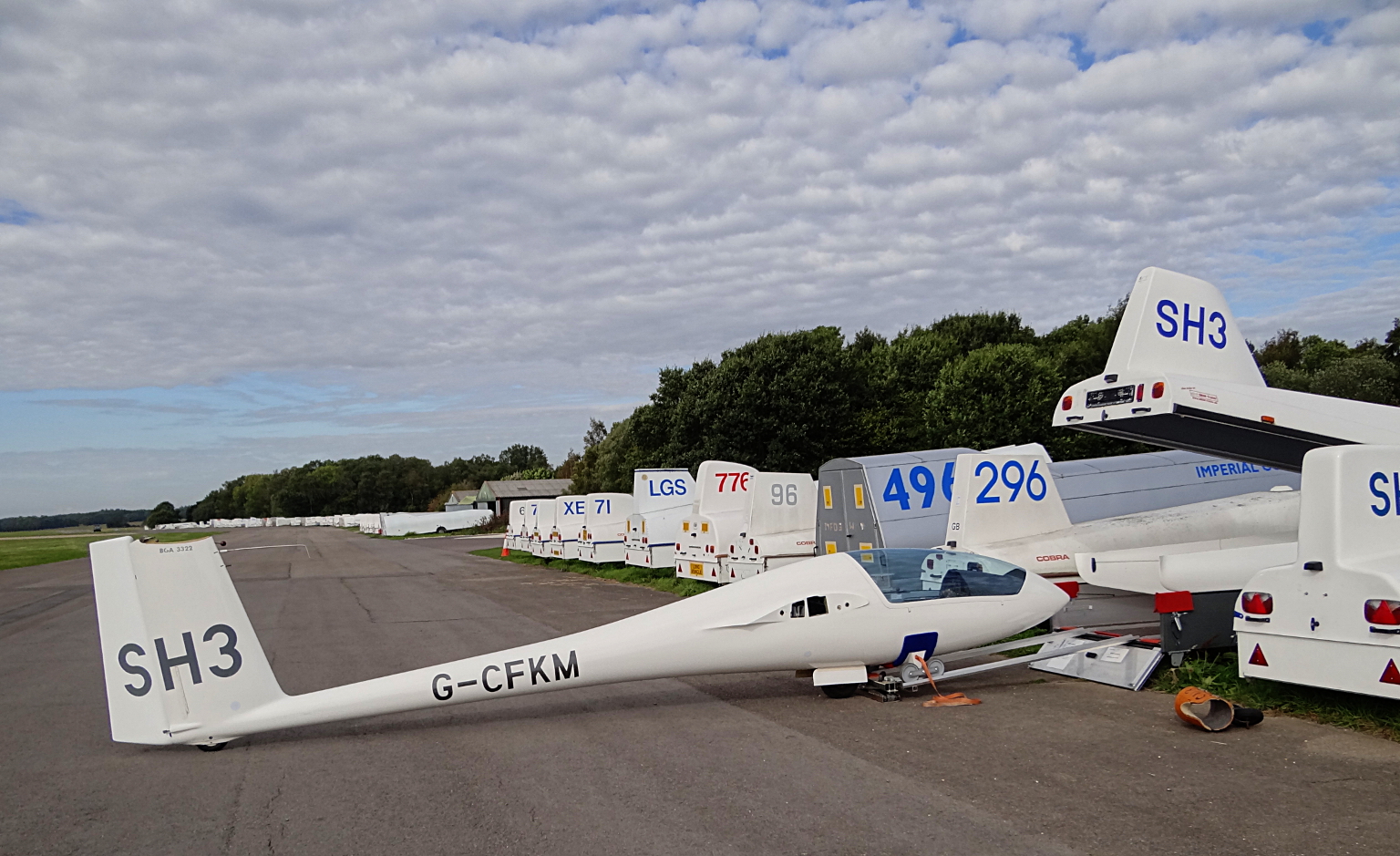
When deciding which single seater to fly, I had made another “lazy” decision to take SH7, the baby Grob, since I knew it would be rigged. As it turned out it was buried at the back of the hangar so I decided to rig one of the “Modern Beauties“, Discus SH3 as I expected this would be less of a chore to get ready for flying. There were 6 other gliders in front of SH7 in the hangar and a definite dearth of helpers.

The conditions were not looking good as a lot of high cloud was present from the night before. It was going to be a case of waiting for it to disperse, which thankfully it duly began to do during the morning as you can see from the early photos.

The early reports from the initial K13 training flights were that no lift was around, so I decided to take an exploratory winch launch to see what the conditions were like. I expected this to be a short flight that would also get me “rolling” for the day. The plan was then to take an aerotow.

Ahh. Plans, plans, plans – they rarely survive contact with reality.

Getting SH3 rigged

View into SH3's trailer

SH3 rigged, cleaned and ready to go out to the launch point


Up and Away – but only just
By the time I had the Discus rigged, cleaned, over to the launch point, and sorted myself out – it was 12:15 and the conditions were just starting to get going. There was a medium strength southerly crosswind and we were launching on runway 09 towards the east.

I queued up, got strapped in and waited for a cable. The winch launch was unremarkable, though only a 1300ft launch height – I am still not getting good launch heights with the single seaters. However it was enough for some minutes of bimbling around and I decided to go upwind to the south of the airfield. This was to cause a few problems later but did result in finding some lift.

I flew around and did not manage to pick anything up until eventually I saw another glider coming in below me to join the circuit from the south-east and I decided to follow it in. I was pretty high as I began my circuit, and as part of the pre-landing checks put the undercarriage down.

All was going fine and I was expecting, as planned, to take an aerotow next. But then at around 700ft on the downwind leg I got the most amazing kick up the pants as I hit a 4up thermal. I am afraid I could not resist it since (a) I knew I had enough height and (b) knew there was no-one else in the circuit. After just one turn I knew I had a good one and put the undercarriage back in its box.

So all was going well and I climbed up to 1000ft but the next problem as alluded to earlier was that I was now drifting close to the launch area. I could also see that they were getting ready to launch a glider so I had to leave my beloved 4up thermal and go further south, upwind and away from the launch area. The waiting glider below was now being launched, but I had lost the “biggie” and was only getting weak 2up thermals, though enough to keep me at my height.

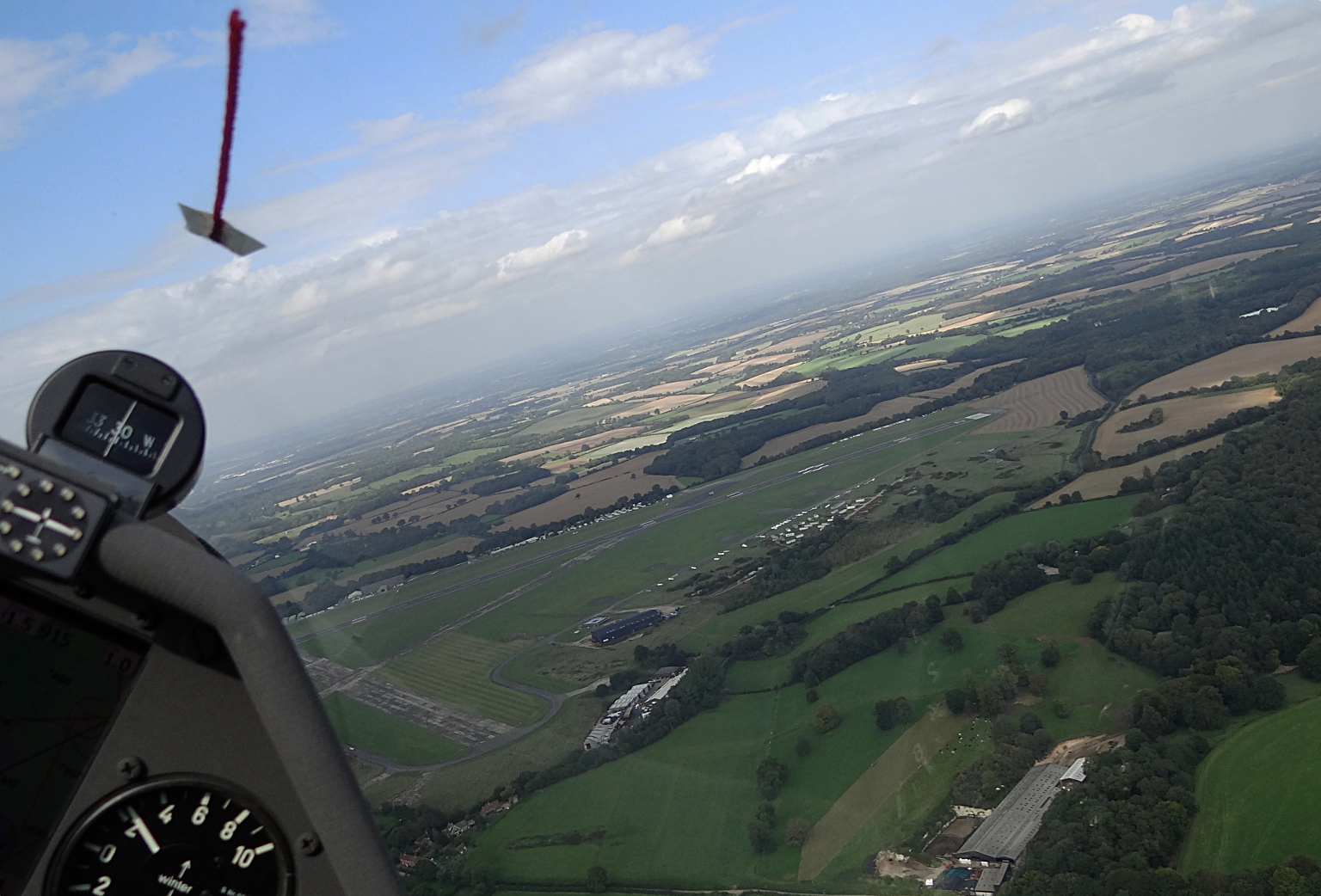
Thermalling on the south side of the airfield. The launch point is on the left hidden by the glider


At last another good thermal came along and I took it, beginning the inevitable drift back over the launch point as I circled. This time, however, I could see that they were not ready to launch so I called up and asked if I could overfly the launch point. Luckily this was allowed and I happily continued thermalling from the south of the airfield to the north without disturbing their operations, gradually climbing from 900ft up to 1500ft.

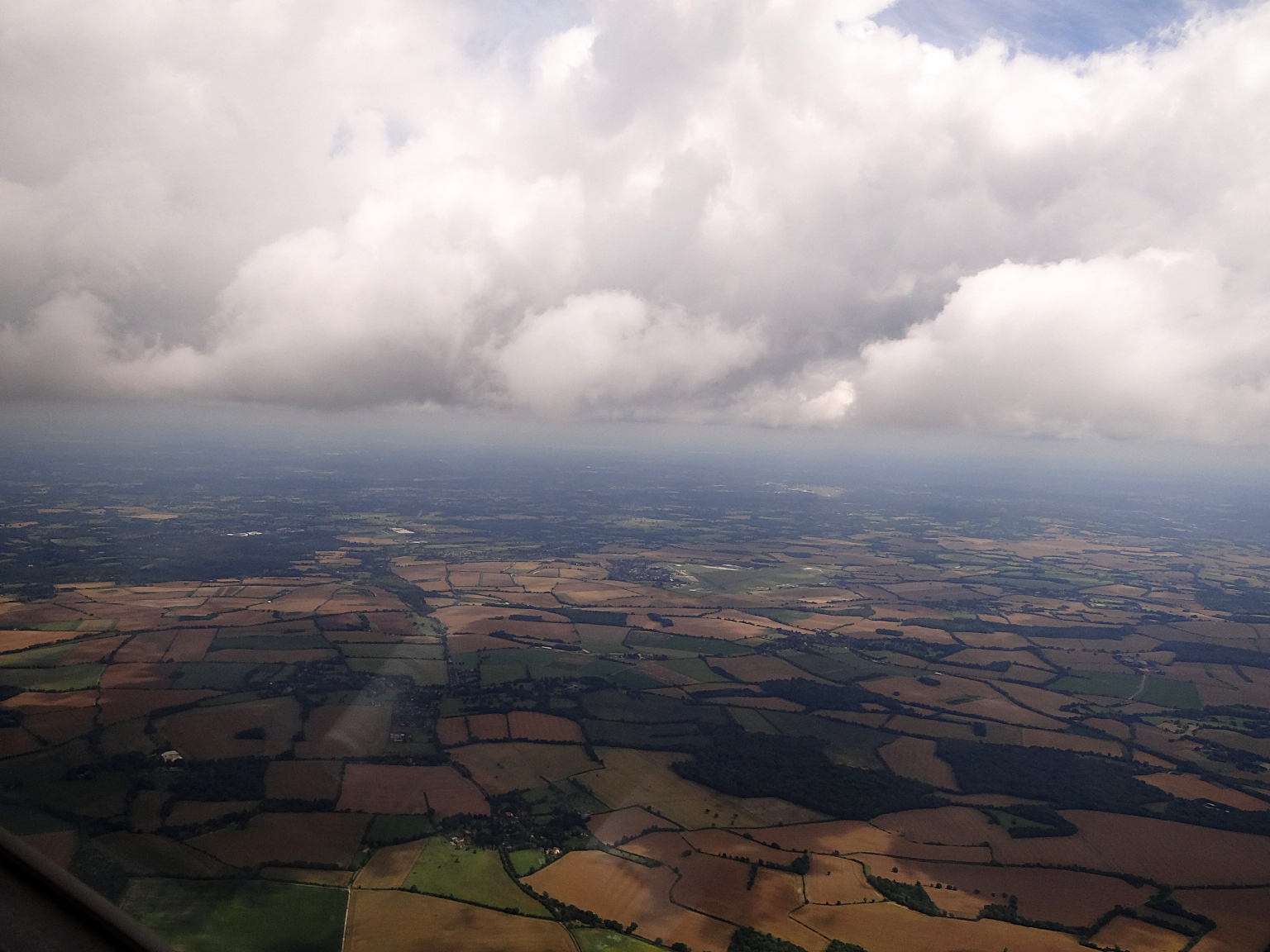
Being on the north of the airfield allowed me to check a bit of theory about thermal formation. I had heard that one should look for places where you would get differential heating. I reckoned I could see one where there was a wood on the south side of a brown stubble field. I was hoping that the air just on the north of the wood would be sheltered from the wind, allowing a big enough bubble of warm air to form which would later get detached due to the windy conditions.
Enlargement from previous photo of the view north. The red rectangle shows the wood and field described in the text where I found a thermal.


I was absolutely open-mouthed when I found this actually worked! It was not the best thermal of the day, but the theory did seem to work. Fantastic! With this thermal I managed to get to about 1800ft, at which height the lift seemed to “top out”. This was to be a consistent feature of the day’s lift.

It was shortly after this that I had my first encounter with a pair of buzzards.
Words fail to put over the feeling when encountering these wonderful fliers. I am not so deluded to think that I am anywhere near as good as they, nor can I claim a close kinship – the best I can say is that I felt linked to them in some small way. Yes – the word is “Participated”. I participated in their world and felt awe at the effortless connection they have with the aerial habitat. I also felt very lucky that I was able to fly with them for the small time I did.
Of course due to my higher speed, I could only fly around the outside of their circles, and as you would expect it was almost a guarantee that wherever they were – there was rising air. I was gratified to see that they were not at all bothered by my presence, being quite happy to pass within 50 metres of the glider, although I was careful to make sure I kept far enough away so that neither they nor myself would be disturbed.

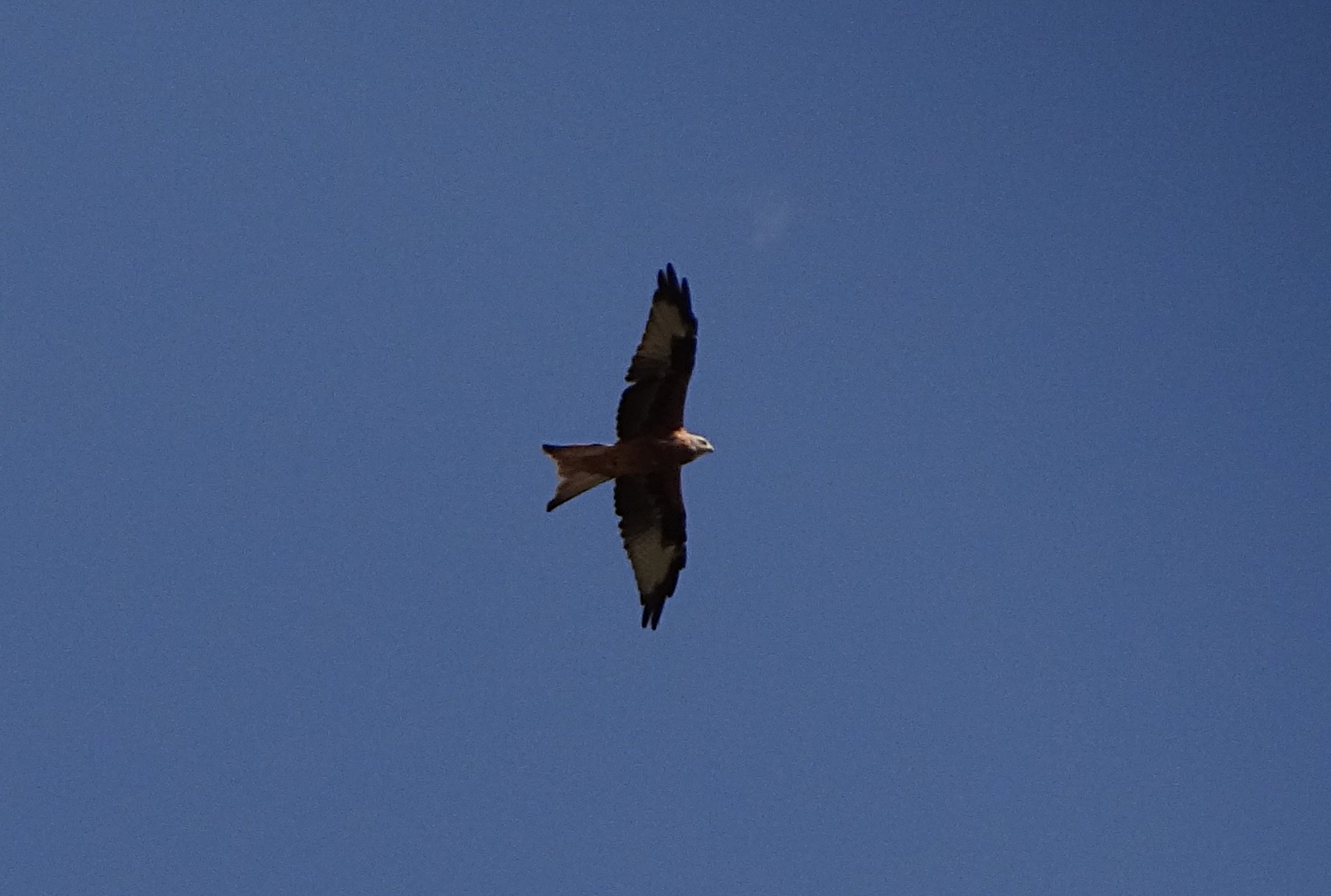
By now I was back on the south side of the airfield where the air was moving in decidedly strange ways, definitely not in nice circular thermic bubbles. I decided to try and sort of “wind-surf” by flying to and fro rather than staying in circles. This seemed to work for a while but “needs more research”. It was at this time that I came upon another buzzard and managed to get some photos which I hope you agree are pretty amazing. Apologies for the angles since they were definitely “action” shots with one hand flying the aircraft and one hand on the camera.

Circling near a buzzard

Emulation is the sincerest form of flattery


The time was now around 2pm and I was getting quite tired as it was proving to be a tussle to stay airborne. I flew around to the west of the airfield as I could see ground movement of the launch point as the operation moved onto runway 23. This coincided with hitting some really strong sinking air going down at 600ft per minute just as I was on the downwind leg of the circuit. I almost thought I would have to turn in early and land crosswind but luckily came out of the sink and found some lift and carried on to return to a normal landing.

I opened the canopy and just stayed in the glider resting and contemplating my experience while I waited for the retrieve buggy. I had just completed a 92 minute flight, I believe one of the longest of the day, and had managed to fly with the birds. Definitely one of those “self-actualising” experiences as Maslow would say.

A day for the birds. Photo of a red kite taken later from the ground near the threshold of runway 23.

Bird of a different kind, but still beautiful.
SH3 waiting to be put back in the trailer.

Late afternoon sun.


And so it was time to go home and Reflect upon the day’s experiences. I hope you enjoyed my Rambling here and that I did not Rumble too much!

Until the next time…

GLIDER CHRONICLES 2011 – September 3rd : An Evening down on the Farm Strip

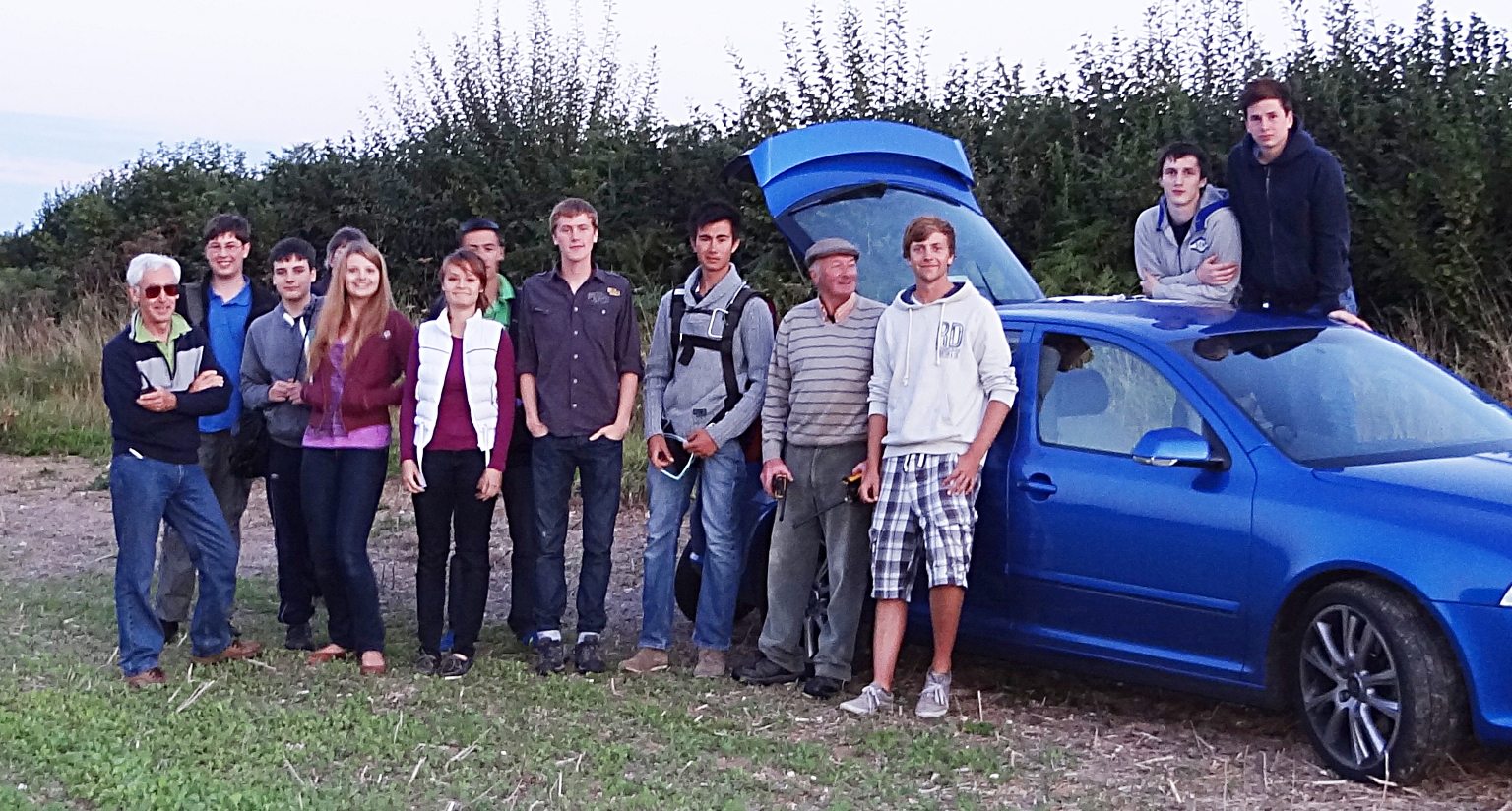
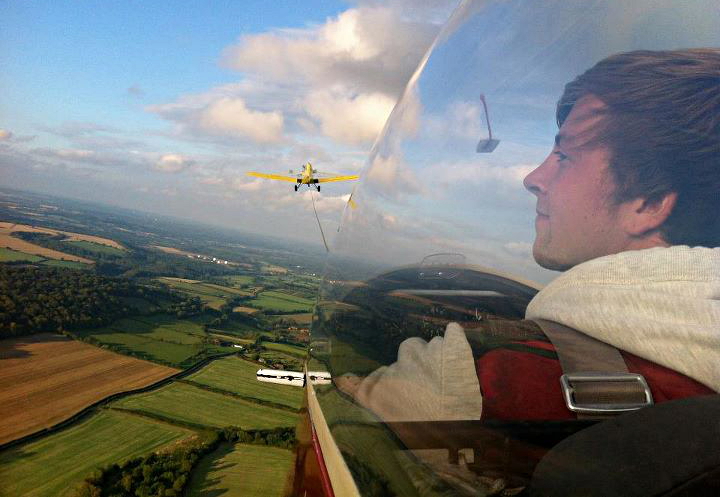
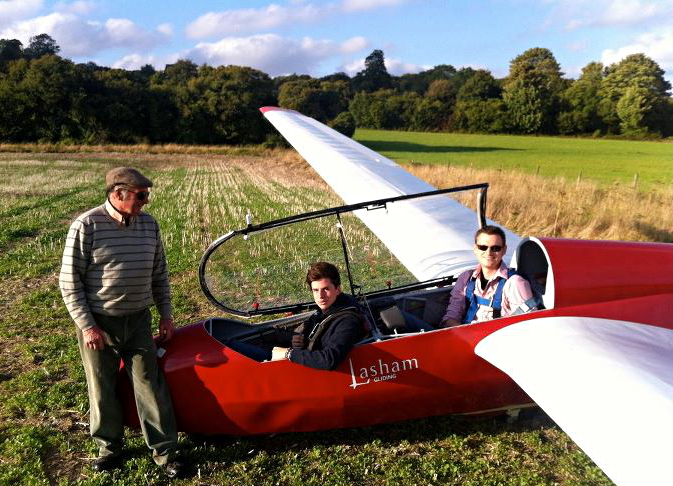
Thanks to the good organisation of one of our instructors – Farmer Dave – we recently had a rare chance to fly from a nearby field at a neighbouring farm. So a group of 25 or so of us, arrived literally “out of the blue”, and descended on a quiet field in the Hampshire countryside.

The actors in this particular play were:

Mr “Full Cat” Instructor
Farmer Dave. None of it would have happened without his untiring efforts.

The Tug
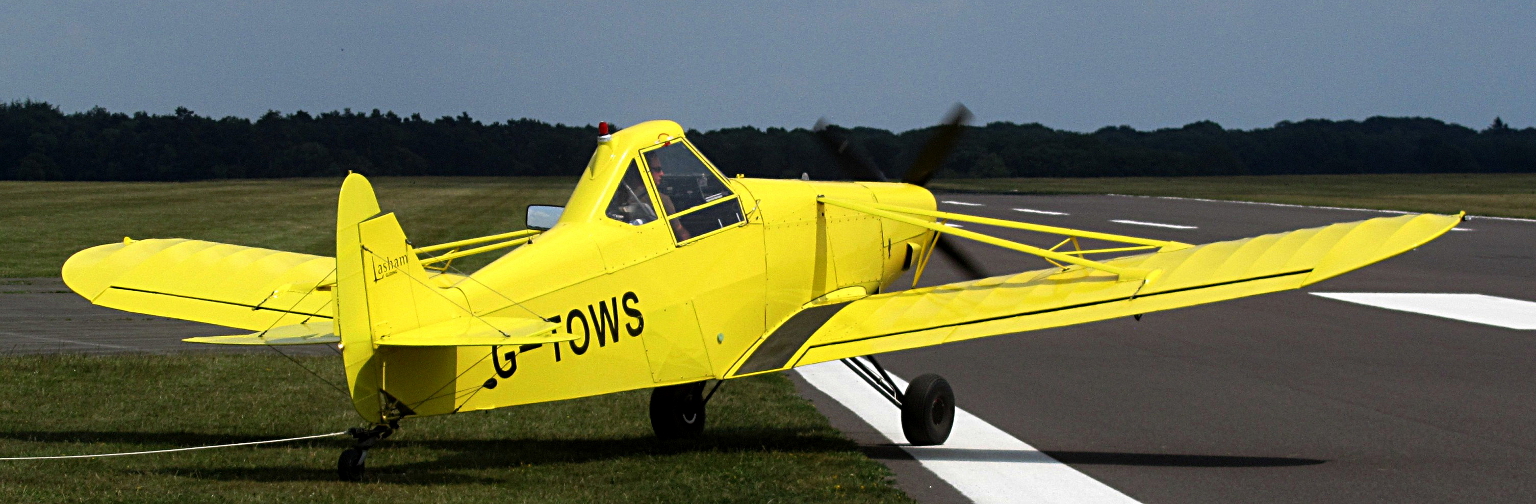
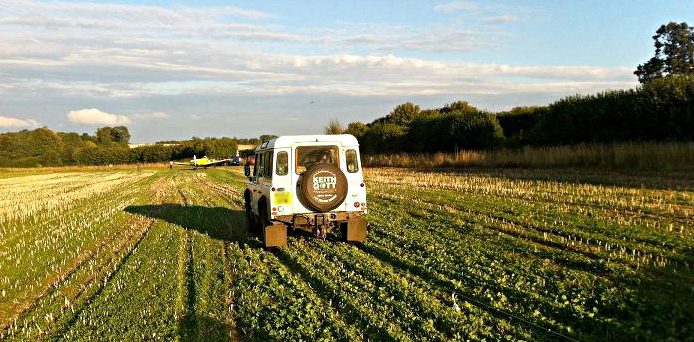
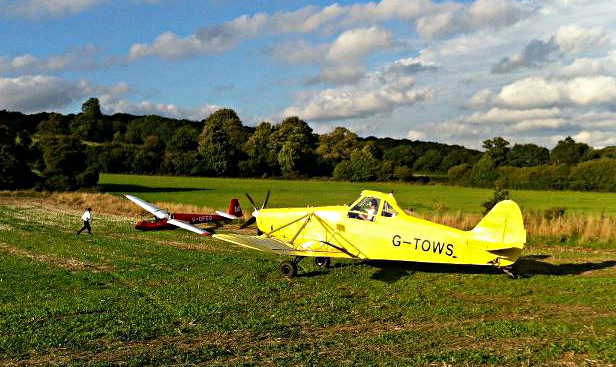
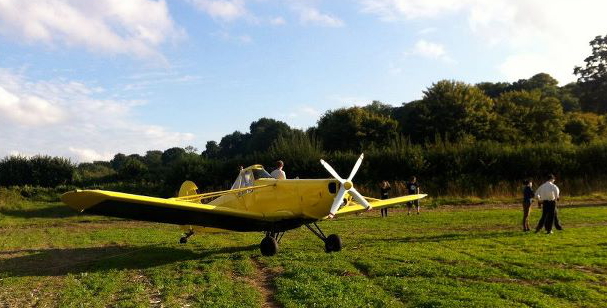
The recently refurbished Lasham Piper Pawnee crop duster tug aircraft G-TOWS, in its bright yellow livery.

G-TOWS Piper Pawnee Lasham Tug

The Tug Pilot
The amazingly highly experienced airline pilot Andy who was to demonstrate some phenomenal flying skills throughout the evening.

The Gliders
Two of the faithful Lasham ASK13’s. There was a reason we only took two as will soon become clear.

Some of the Lasham K13s parked up on a windy day.

The Instructors:
The normal crew of Saturday night youth instructors who were going to put the trainee pilots through their paces at a farm strip. A new experience for some of the instructors, so this was not your normal set of lessons.

The Trainees
About 20 or so young and old flyers champing at the bit to get flying in a small field.

Some of the crew.


Let me explain a little background here: Lasham is a wonderful airfield and a great place to fly, but it has just one problem when it comes to small field landing practice, it is BIG. The main runway is a mile long and so when we train for field landings we have to imagine we only have half or third of the airfield available. This is not the same as actually… errr… only having half or third of the size of field to land in for real!

Now normally it is only the youngsters who fly on the Saturday evenings, but such was the occasion that a number of adults who help out and are also trainee pilots, like yours truly, wanted to have a crack at practising a REAL field landing. Though to get us all a flight we would really need to get a move on – but I am getting ahead of myself.

As ever with these Chronicles, I like to start with the peace and calm before the day’s activities…

In the Calm of the Day
First off, since I was to be the Launch Point Controller for the evening, I wanted to go down to the strip and check it out, as well as timing how long it would take to drive there. This was to be of crucial importance since the 2 gliders were to be launched from Lasham and flown down to the strip fairly close together and some of us would have to turn up at the airfield BEFORE the first one landed in order to tow it out of the way before the second glider landed.

I did mention space was tight didn’t I? This meant we could only have one aircraft on the runway area at a time and would have to weave the 2 gliders and the tug around each other so they didn’t clash. This is why we could only take two gliders. Three would have been too many and would have held up proceedings.

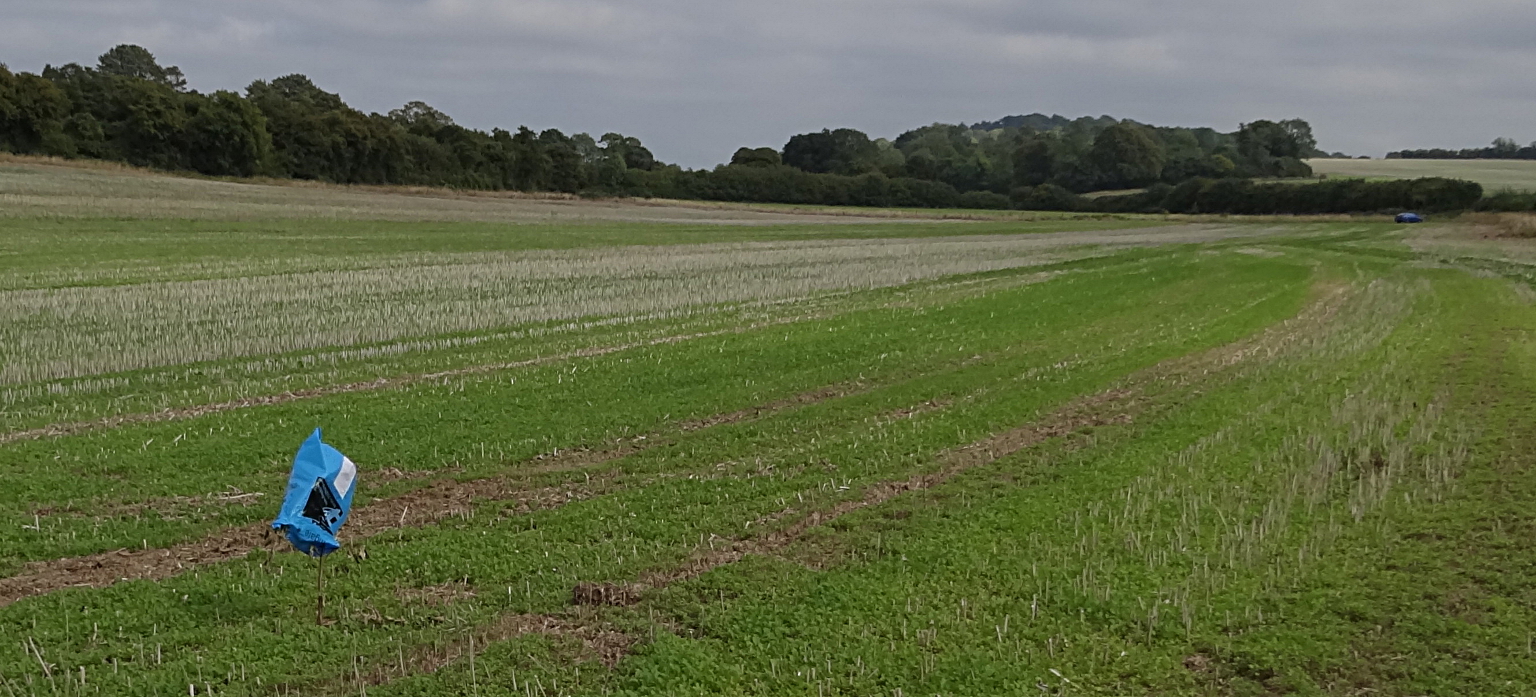
As you can see Dave had put a special high tech farming blue plastic bag where he had mown out the taxiway for towing the gliders back from the landing point.

High tech farm style taxiway marker. My car is down at the launchpoint area in the distance.

Meeting at Lasham Clubhouse
After having sized up the field and got my head around how the evening’s proceedings were likely to unfold, it was back to the clubhouse to wait for everyone to turn up. By 5pm all were gathered and we had a quick briefing and decided which young pilots would fly the gliders over to the field. They were to be aerotow launched by some of us from Lasham who would come over later.

As soon as the decision was made I had 2 spare parachutes packed into my car and grabbed 4 passengers and we drove off to the farm strip toute de suite, pronto not to say immediatemente. As mentioned above, time was of the essence as we had to be there in order to tow the first glider arrival out of the way.

Fred towing back a glider to the launch area.

Arriving at the Farm Strip
It was just as well we didn’t hang about since as soon as had we parked up and got ourselves organised, the first K13 was starting its circuit. Thats the great thing with aircraft, they can go in a straight line!

So off I went with my car to the blue taxiway marker and got ready to tow it out of the way. It was Farmer Dave along with Ella. Because of the faster-than-walking-pace idle speed of my car (indeed of most cars) they had to trot back with the glider, despite me slipping the clutch.

Luckily just after that, Fred the Man with the Land Rover, turned up and as “The Controller” I volunteered him for glider retrieve duty. Another one of those unsung heroes.

Soon afterwards Andy arrived with the Pawnee and landed DOWNWIND. For those that don’t know, downwind landings are tricky because they take up so much more distance. They can increase the landing run by over half the length of an into wind landing. During the evening the amazing Andy was to do all of his landings downwind, a strategy that (a) saved time and (b) saved fuel since he didn’t have to land into wind and then backtrack down the runway towards the next waiting glider. Another factor was that all the aerotows were to only 1500ft, lower than the normal 2000-2500ft you would expect. Again this was to save on fuel and meant we managed to get 20 launches done without refuelling the Pawnee.

Fast Turnaround
If you were on the ball you would have noticed that I said I had packed 2 spare parachutes in the car. While the first landing glider was retrieved the NEXT pair to fly, instructor and trainee, donned these parachutes so that when the retrieved glider was back at the launch point, they could get straight in. The rest of the crew would then push the glider back to the launch position while they went through their pre-takeoff checks from the cockpit! Normally you would have time and space on the airfield at Lasham to do this in peace, but we had neither of those commodities. Needless to say we had to try and be calm about it so that the checks were done properly and were not rushed.

So within 5 minutes of having landed, we were able to launch the first glider from the strip before the second glider had landed. Wow! I could see this was going to be a busy evening, what with:

– Immediate retrieves of the landing gliders.
– Downwind tug landings.
– Parachutes ready for the next flyers.
– Pre-takeoff checks while being pushed back to the launch position.
– plus seamlessly slotting in the launching and landing aircraft.

And so it was, but also fantastic fun. I did not manage to get any action shots since I was running around like the proverbial Blue A**ed Fly arranging who was to fly next and then controlling the launches from the radio. However thanks to Jon, one of the instructors, most of the following shots should help give you some idea of the action packed evening.

Pawnee firing up for the next tow. Yours truly running up to attach the glider.

Alex "On Tow" with one of those flying grins.

The Pawnee waiting for the next launch while...

Farmer Dave gives some pre-launch advice to Joe and Tom.

Yours truly on finals to land in the field - hopefully.


Spectators
We had many spectators during the evening who must of wondered what hit them with all the activity. I mean – how often do 20-30 people turn up with 3 aircraft for 2 hours – fly around the sky a bit – and then disappear into the dusk? Some of the locals even had a barbecue party up on the hill overlooking the field to watch the action from a safe distance.


So, once again, a fun filled evening, a great experience for young and old-ish alike, and that wonderful “Ahh” feeling at the end of the day.

What a great way to spend an evening in the fresh air and the beautiful English Hampshire countryside. THANKS FARMER DAVE.

The evening sun sets over the field after the last flight has left.

GLIDER CHRONICLES 2011 – August 13th: Modern Beauties – Part 2

So – The story so far. I had just completed the Duo Discus check flight with Chris, my instructor and it was still the morning (just), so the next thing to do was to get one of the Discus single seaters rigged and for that I needed to get hold of someone knowledgeable in such things.

Discus SH3 sitting in its trailer

Let me explain: The three club Discus gliders are kept in trailers rather than in the hangar ready to go. This means that if you want to fly one you have to enlist the help of at least one other soul and put it together – a process called rigging. Luckily the Discus is really easy to rig. Usually on a good soaring day there are a few people who want to fly the single seaters so they all help each other.

However, this was not a good soaring day and could I find someone to brief me in the requisite art? The phrases “hens teeth” and “gold dust” come to mind. Most of the instructors I talked to used to own one but had not rigged one for many years now and were too rusty. In the end I was pointed at the famous Merv, a well known character and fount of knowledge at Lasham who also got his mate, Dave, a current Discus owner, to help out.

Merv is very knowledgeable, an instructor, and possesses a particularly laconic temperament. This coupled with my own psyche resulted in me apologising a lot of the time for disturbing him. My apology rate abruptly increased when I found I had left my diligently purchased BGA wing sealing tape at home and had to borrow some of Dave’s. The guilt rate went up even further when Dave used his car to tow the rigged Discus out to the launch point because yours truly has no towbar on his car! Yeah. I was feeling fairly small by this time, but Dave was great and helped me out in getting ready. Merv was also helping out and doing his instructorly duty briefing me about the flying as well as being ready to observe my performance.

After some final recommendations from Merv to watch out for PIO (Pilot Induced Oscillation) on take-off due to the sensitive elevator I got myself strapped into the cockpit. The radio seemed to have a dodgy connection, but once I jiggled with the panel and its knobs it came good. If it did stop working it was not going to be an issue since this was only going to be a local flight to get the hang of the glider, and given the prevailing conditions it was going to be a short one. I normally carry a spare radio if the conditions are good so that I can either use it as a spare should the main one fail, or sometimes it can be useful to listen to two frequencies at once.


While waiting for the aerotow I was feeling fairly nervous, so just sat in the glider while I waited and calmed myself down and managed to relax. The tug pilot was told I was a Discus virgin (actually the phrase used is: “First time on type”) so knew to treat me gently!

I went through the pre take-off checks and was hooked on. During the take-off run, the elevator sensitivity was noticeable and I did have a couple of PIOs but got it under control fairly quickly. After that it was another lovely flight, albeit under rather overcast skies.

The glider handled very well and I landed back near the trailer where Dave was waiting with his car to take the glider back and help me derig it and pack it back into the trailer.

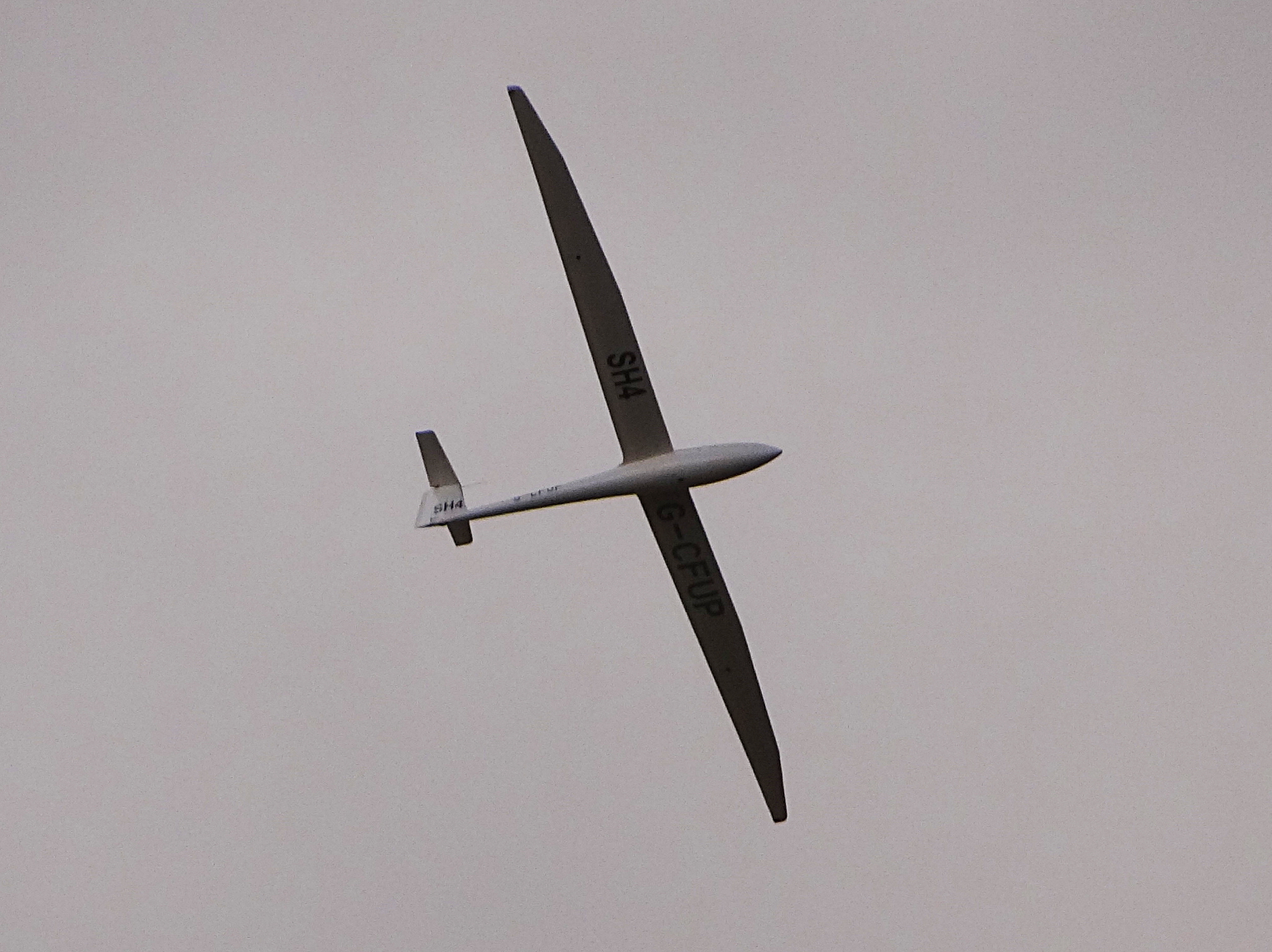
Shot of SH4 showing the Discus wing shape.

So many thanks again to Merv and Dave for helping me out with becoming current on the Discus.
I am looking forward to many hours of great soaring in these “Modern Beauties”.

GLIDER CHRONICLES 2011 – August 13th: Modern Beauties – Part 1

Recent flying has been hampered by the weather, but I have managed to convert myself to flying the newer Discus single seater gliders, of which Lasham has three. These are beautiful fibreglass and carbon fibre aircraft which were initially built in 1984.

For local soaring flights I had managed to get all the necessary “qualifications”, apart from the final check flight:

1: Bronze ‘C’
– Yep. Got that.
2: 20 hours solo flying, including 10 hours in the Grob102 or similar (i.e. a glas fibre single seater)
– Yep. Got that too.
3: Briefing and check flight with full cat.
– Don’t have that – so this was the day to go and get it.

What on earth is a “full cat”? This is a Full Instructor or FI as the BGA calls it. There are various categories of instructor ratings from those who are “Basic Instructors”, usually the folk who do the trial flights, up to the “Full Instructor” rating that is the person who needs to do this check as well as be on hand to run a launch point.

So – given that there had been a dearth of good soaring days, it was time to get myself converted, although I am still not quite ready to go cross-country as yet. I am only able to do local flights closer to the airfield. For cross country I am going to need to get what is called a Cross-Country Endorsement. This is part of the Red Card and will need two flights with an instructor to cover field landings and navigation. Hopefully coming soon!

Anyway – on to the day’s proceedings.

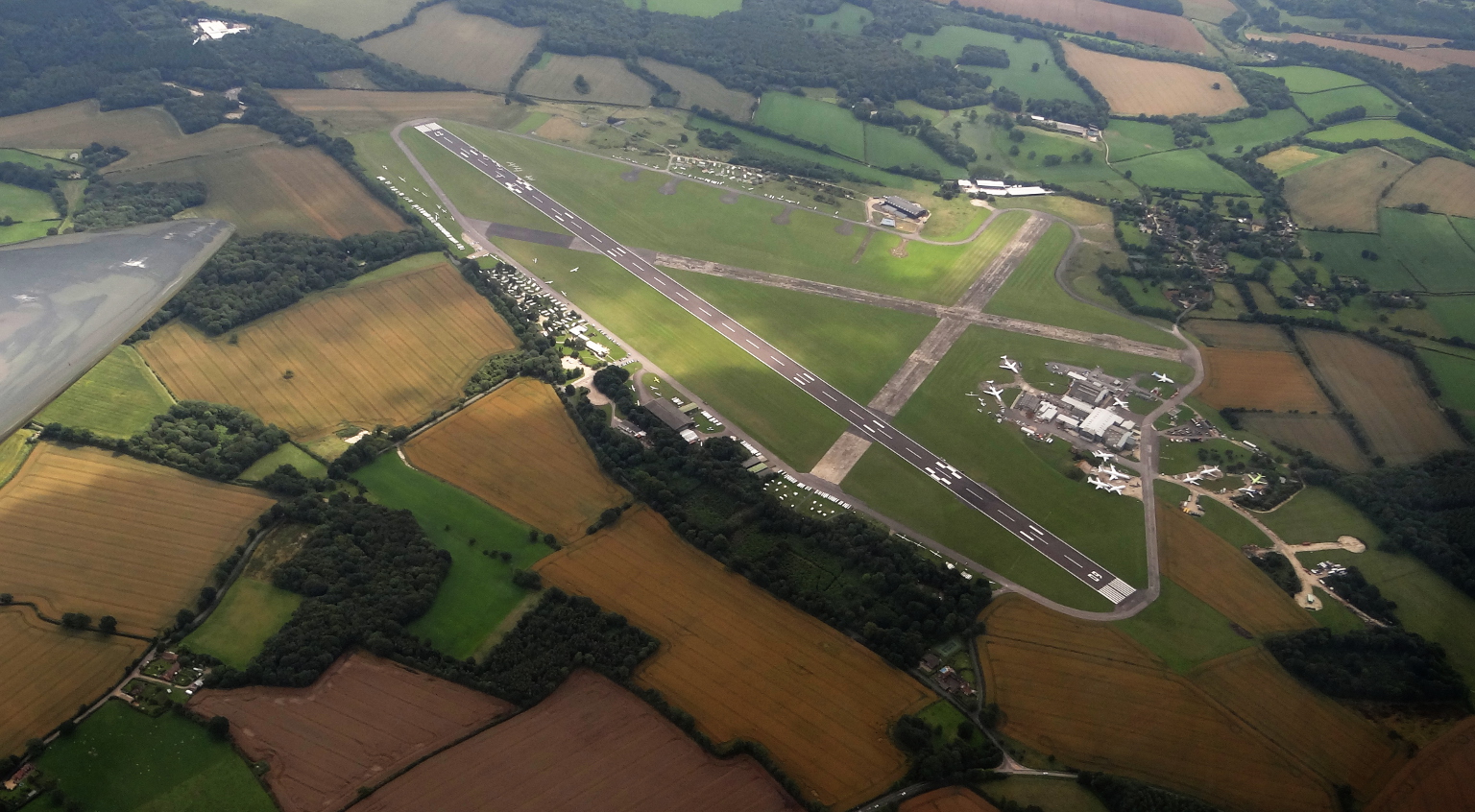
A wet and dreary Lasham after the rain the night before. Not looking great.

As you can see the morning started with water on the ground since it had been raining copiously the night before. It had also been a hectic week for me at work so it was a difficult thing to raise my sleepy head to get to Lasham when I could see it was not set to be a great day. The forecast was for overcast skies which, as you can see, turned out to be correct. However, I was determined to get the conversion done if possible.

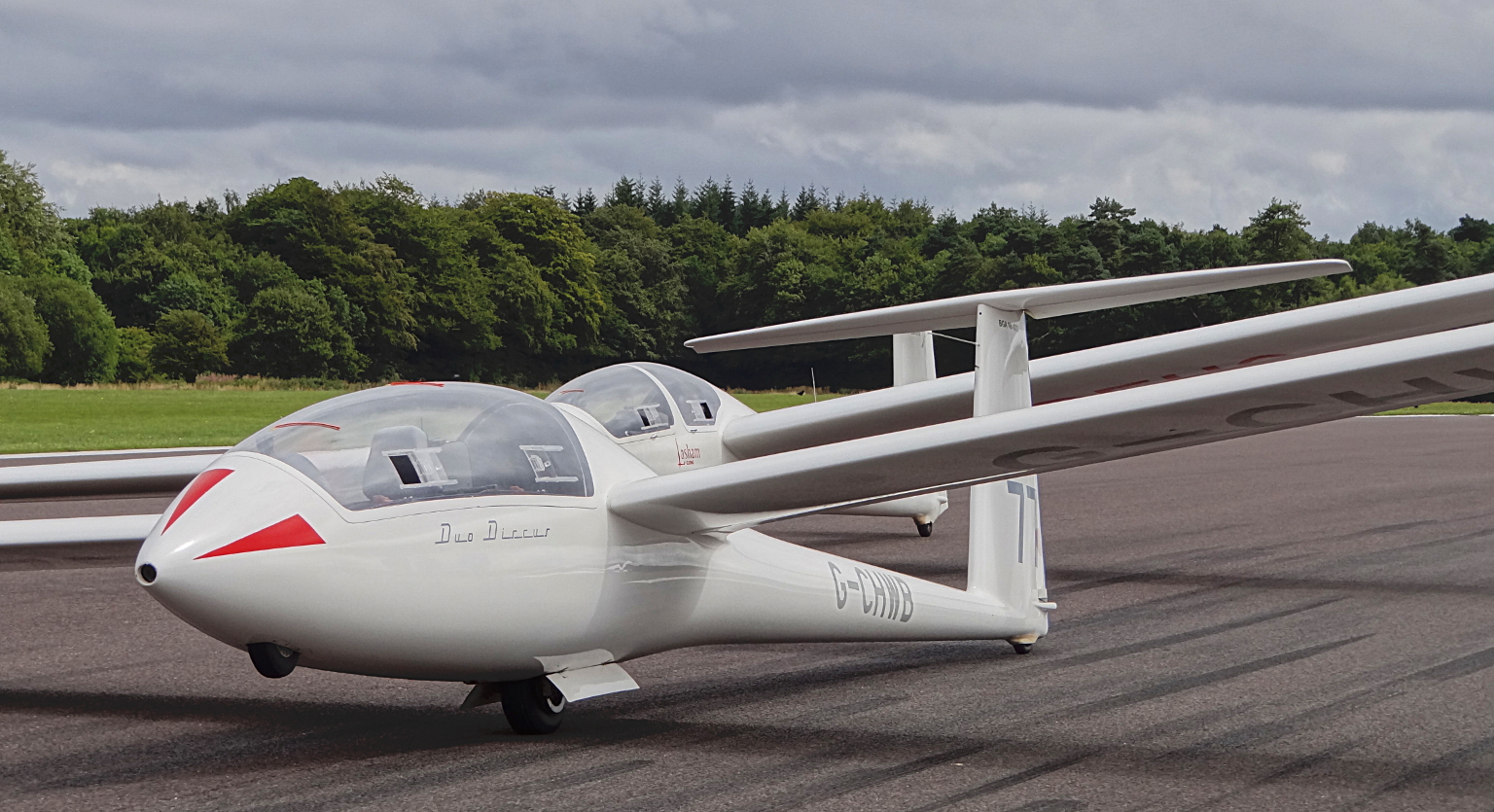
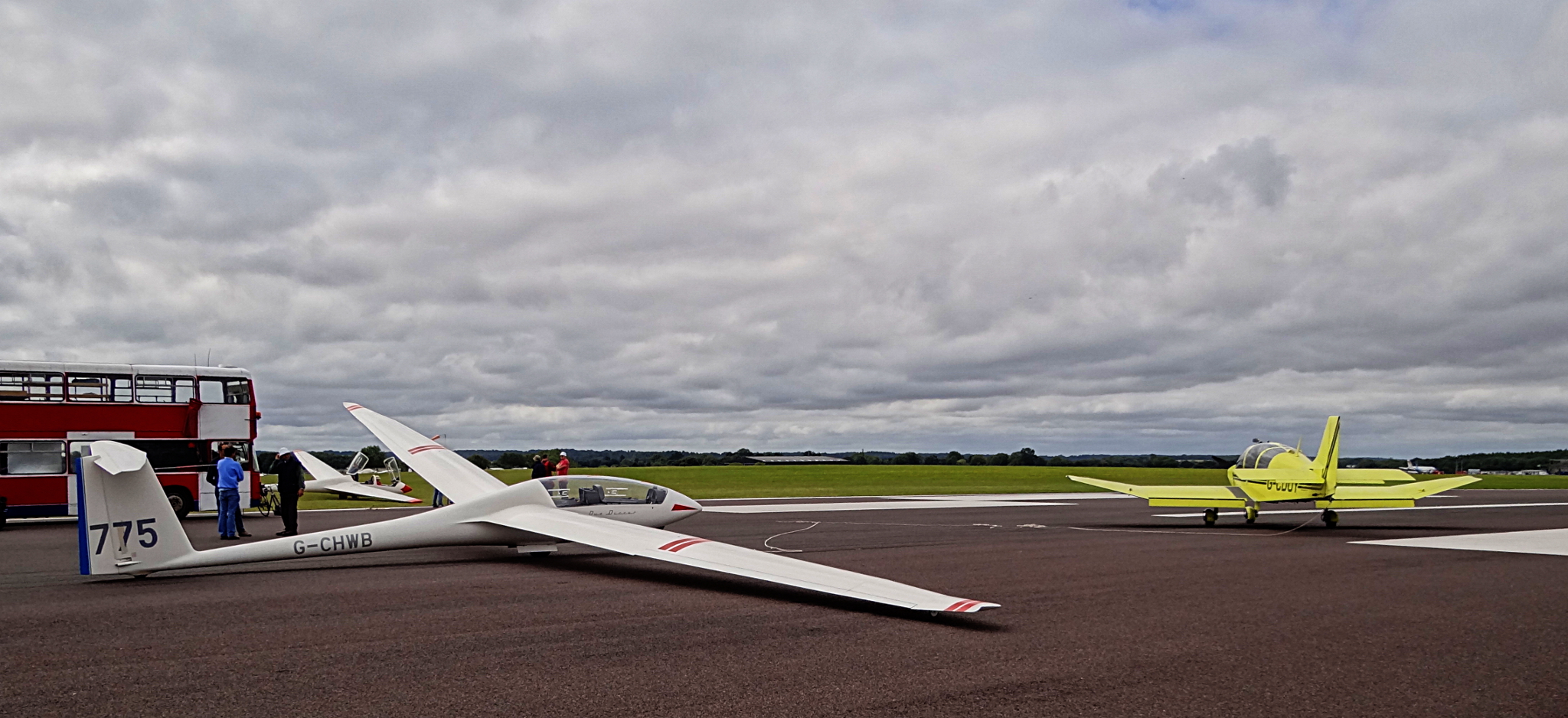
After having got an ASK21 out to the launch point and having grabbed an instructor, the CFI recommended that we should really get the Duo Discus trainer out. This is the 2 seat version of the Discus, and as I found out later is an absolute joy to fly so the initial exasperation at having got the wrong glider to the launch point was soon overcome by the fun of playing with a new toy! Also the K21 would not go unused so I was not too bothered. I always like to feel I keep the “social credit” in the club topped up.

One of the things I really like about this sport is the beauty of the flying machines. They are lovely to look at and I can sometimes quite happily just sit there gazing at them. The next thing I like to do is go up and touch them – usually done under the disguise of cleaning the glider! Of course I also then do the nerdy thing of looking into the cockpit and checking out the toys – whoops sorry – instrumentation, in them.

I suppose the closest thing for me in a powered aircraft would be the Spitfire, but gliding is cheaper and not so noisy! Plus I can have that supercilious grin of feeling more “green”, just.

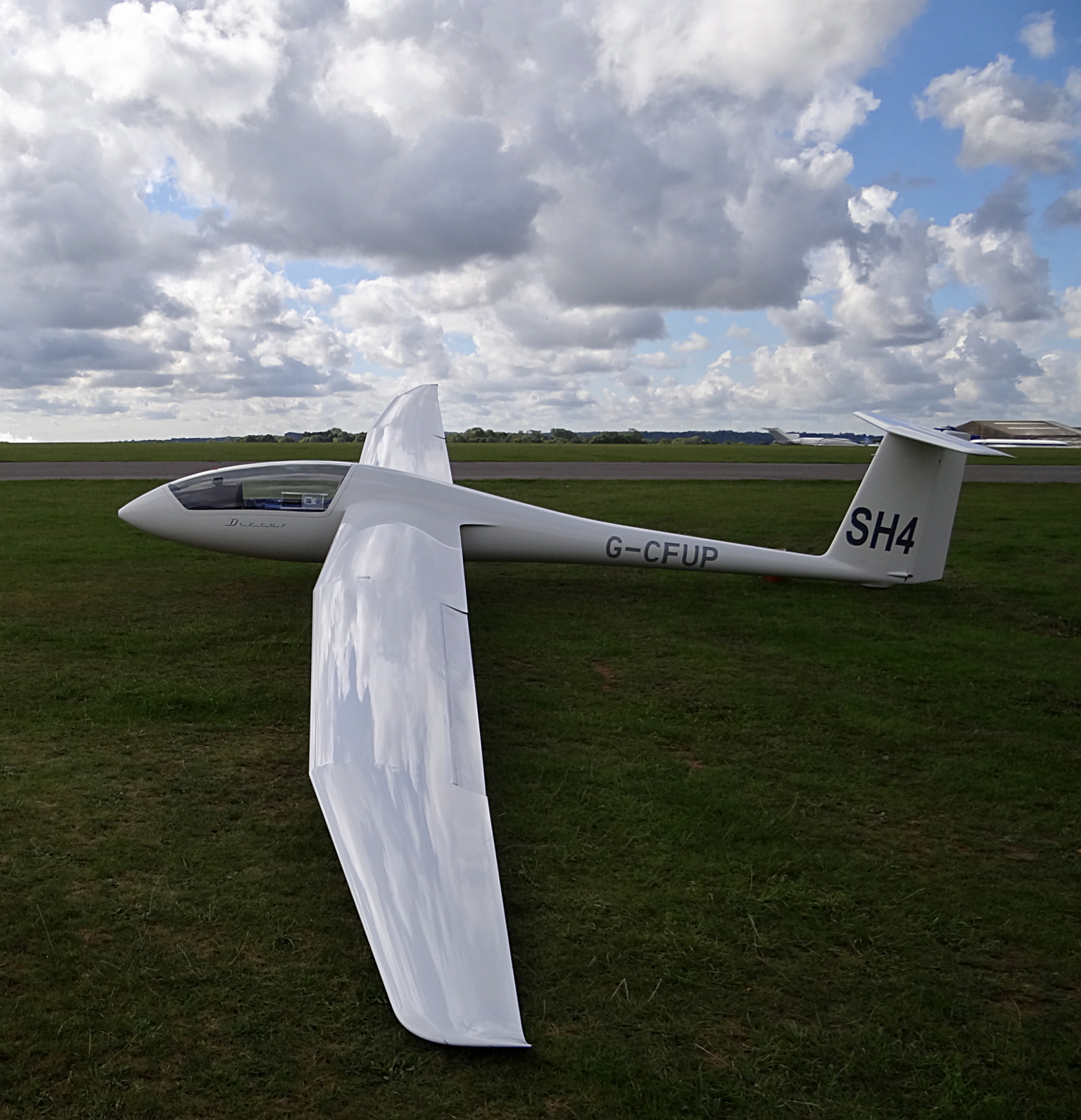
Lasham Discus SH4.

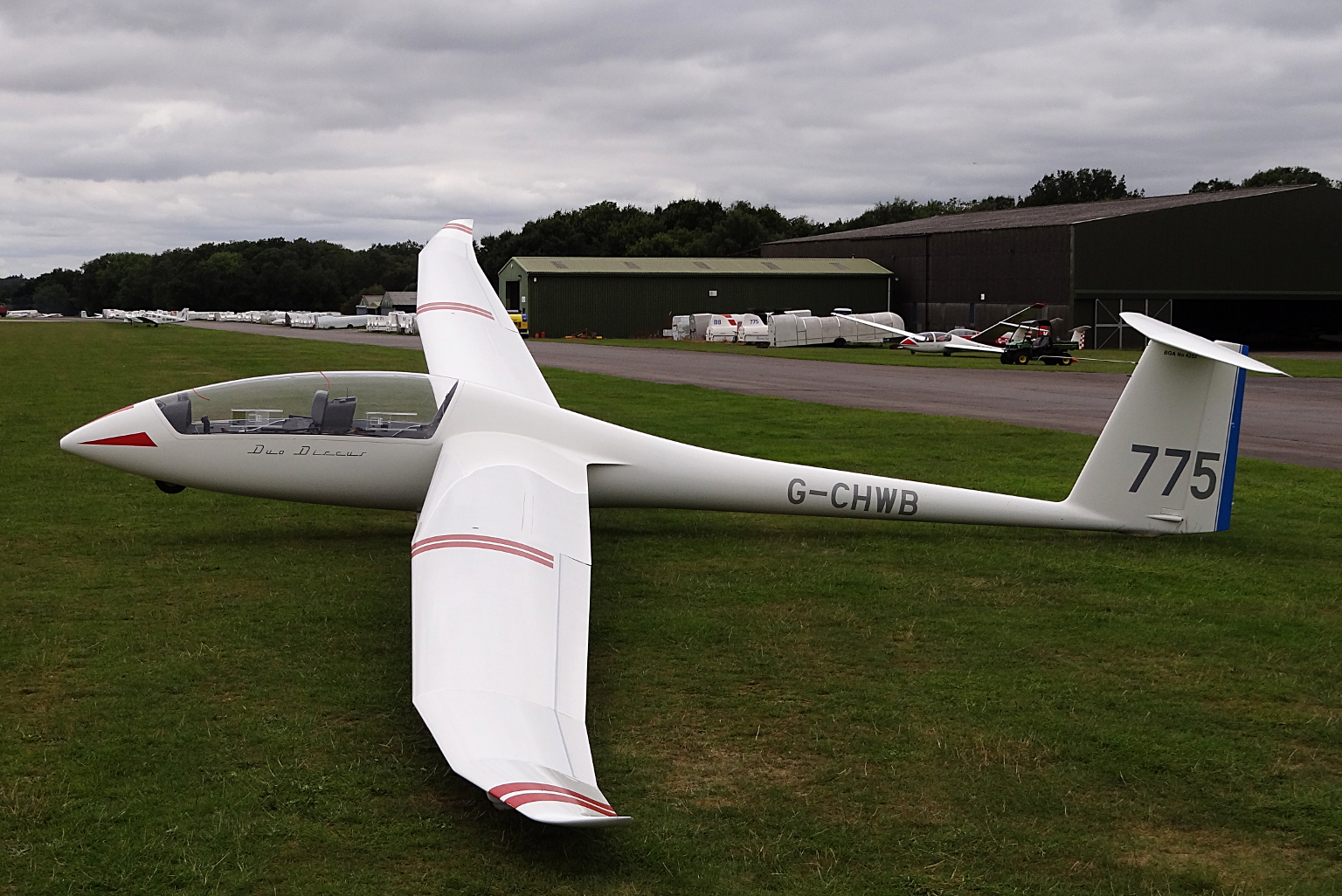
The Duo Discus. Love those swept wings.

The recent Arcus, but can't afford this.


You can see from the accompanying shots that both the Discus and the “Duo” have swept back wings, in common with many modern gliders. This is to reduce what is called induced drag. I have also included a shot of the most recent glider from the same company, the Arcus, which I happened to see at a recent competition day at Lasham. If you look you can see that the Duo and the Arcus have the same fuselage sections although I only found that out from the Arcus’ Wikipedia entry.


Explanation: Drag

Whether you are designing an aircraft or a racing car, trying to swim faster, or leaning into a strong wind, you will be familiar with drag. Drag is the force that tries to stop you moving through a fluid medium, e.g air or water. But just considering aircraft, drag is generally broken down into two main types: Parasitic Drag and Induced drag.

Parasitic Drag is the drag that happens just because you are moving through the air. Just like when you hold your hand out of a moving car’s window, flat on to the airstream. By streamlining the shape you can reduced this drag. Hence the reason gliders (and fast fish!) have pointed noses. This type of drag increases the faster you move through the air.

Induced Drag is rather more subtle and happens as a by-product of the lift generated by the wings. While flying, as the airflow leaves the ends of the wings it becomes a vortex. [Good image here and you can see my previous photo]. This vortex causes drag on the aircraft and so a lot of research is done to make glider wings that produce as little drag as possible. This is also a reason why you will see winglets on many aircraft, from gliders to airliners. This type of drag decreases the faster you move through the air.

That is but just a quick introduction to the world of drag.

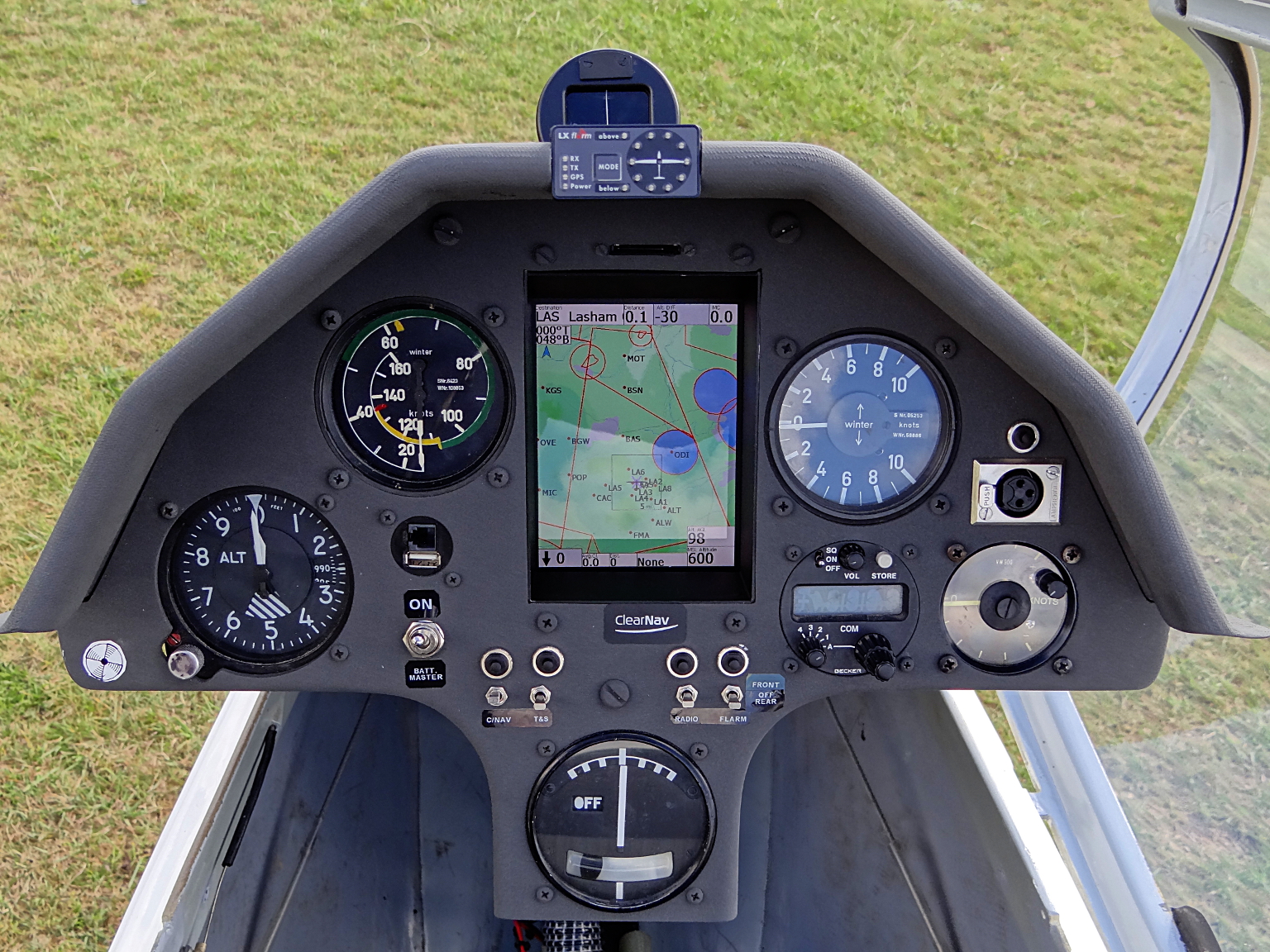
The Discus panel. Clear Nav in centre.

Once the Duo Discus had been checked over we brought it out to the launch point ready for an aerotow and I climbed in to familiarise myself with the cockpit layout. OK. Read that as: I climbed in to play with the GPS system. The Duo and the single seater Discus gliders all have a “Clear Nav” GPS system which is a real help when flying. So, yours truly being one of the original nerd types, I am able to have a wonderful time both flying newer gliders and playing with computers. Great fun!

For the pilots among us, at the time of writing the online Clear Nav manual can be found here. I find this more useful than the PDF version of the manual.

When I had familiarised myself with the controls I climbed out of the cockpit. Wow. It is really deep and I was pulling muscles in my arms I didn’t know I had. Looks like more trips to the gym are required.

Once out of the cockpit I was all raring to go and so . . .

We waited . . .

Waiting . . .

And waiting . . .

So there I was – I had the glider, the instructor was there, the tug plane was available, but the English weather was not cooperating. The cloudbase was too low at around 1500ft for an aerotow to be worth the money.

After my initial accommodating behavior of just waiting 30 minutes and chatting at the launch point and being sociable (I am a very accommodating and sociable person!) I got fed up with waiting and said to my instructor: “Chris I am fed up with this – lets take a winch launch”. So we moved the glider to the winch queue and we took a wire launch.

I could notice immediately just how lovely she was to fly (yes the aircraft are always ladies). We even managed to contact some weak lift and stayed airborne for 11 minutes. Not too bad for a winch launch on an overcast day. By the time we had returned a report came back that the cloudbase had risen and so we were ready for the aerotow.

When flying the single seater Grob102 or Discus the first launch must be an aerotow since it is gentler than a winch launch. For the Discus, the elevator control is more sensitive so the check flight is best done with the Duo Discus. I must admit that I didn’t have a problem with the Duo, but definitely noticed the difference with the single seater.

As I mentioned before I found the Duo a lovely glider to fly. The main foible was the undercarriage. My instructor, Chris, mentioned that you really needed to make sure that it was locked down since the lever could come out of the détente. Also the instructor is not able to lock the lever from the rear cockpit – he has to have faith that the person in the front has done so properly. To try and reassure Chris I had locked it properly I gently thumped the lever to the cockpit wall after I had put the undercarriage down!

Again we found some weak lift but I was mainly concentrating on getting used to the handling. After giving myself more space in the circuit thanks to Chris’ advice, we landed back and Chris signed my log book with the words:

Check for solo Discus. OK. Well handled.
Also, since the sign-off for the Discus is on the Yellow Card I went back to the office and he signed that entry on the card.

Great! Another milestone reached.

It may be a naff (technical term meaning Not Actually Fully Functional) day weatherwise but I was checked out for the Discus. The only thing left to do now was to go over to the clubhouse and find an instructor prepared to brief me about rigging the Discus. Now this is a whole tale in itself and I think I shall leave it to the next posting . . .

Coming soon – the tale of the lesser spotted Discus rigging briefer and yours truly apologising profusely.

GLIDER CHRONICLES 2011 – August 11th : Feeling Connected with the World

I have just been watching yet another TED talk about the disconnect between humanity and the world. The speaker was quite angry at times and, as usual, I found myself feeling uneasy about such one-sided anger. However later in the talk she also pointed out that the good and the bad go together, which showed she had a more measured response, and I felt her anger could then be used in a positive way. Until we get the disconnect in ourselves dealt with, it is difficult to make much progress with our disconnect at a local level, let alone a global level.

Since I had just returned from the flying club this weekday evening, my thoughts strayed onto my flying – of course! This evening I don’t have any photos, just my thoughts. It was just one glider flight. Only 6 minutes. Overcast conditions. Winch launch to 1300ft, followed by some bimbling around before getting into the circuit and sideslipping down on the approach rather than just simply using the airbrakes.

After having left home at 7pm, I was back by 9:15pm, and then took the dog for a walk. On the walk I was looking at the cloudy sky, which by now had some lovely red in it as the sun set, and I spontaneously started laughing. This was just like I have done when flying on one of the longer daytime flights, and it surprised me. What on earth was going on?

I realised I felt more complete, more connected to the world by having had that 6 minute flight. From the ground I was not just looking up at the clouds as I would normally – I had been up there! I had seen their shapes, experienced their air currents, flown around their wispy fingers. I had connected with the air currents that had started thousands of miles away, no matter how mundane they may seem when they arrive in this country.

I felt I had launched myself into the air and touched the world.

This experience – this connection – turned what was just a normal, “standard”, day into a beacon in my memory.

As I reflected after watching the TED talk by Eve Ensler (author of The Vagina Monologues), my mind returned to a chat I had with someone who had returned to gliding after having been doing a lot of sailing. He said he liked gliding better because you had only yourself to blame if you didn’t gauge the weather well and didn’t complete a cross country flight as planned.

To be a good glider pilot you need to train, but you must also connect with the sky and its variations. And when you make this connection, you get the chance to feel complete, because after all you are a being of this world.

No wonder I was laughing! I felt part of the world, and know I will sleep well tonight and sigh contentedly as I lower my head to the pillow.

Once again, a happy man, and feeling lucky to be alive.

Good night.

GLIDER CHRONICLES 2011 – July 23rd : Gliding with Seagulls

The previous weekend had been a real stinker as far as the weather was concerned with rain and more rain in the middle of July. So I was glad on Friday 22nd that the forecast for the Saturday said it would be soarable. I set the alarm the evening before and even missed out on going to a party because I knew I would be up early and flying the next day – such dedication. A shame as I enjoy a good dance and later heard it was a good shindig.

An early start the next morning getting to the club for the 8am glider ballot with my eye on the retractable version of the Baby Grob – SH7 – which I had flown the previous time and really liked. As it turned out there were only two of us each having a choice of three gliders so no need for drawing lots and we put our names down for our respective aircraft.

Then I noticed an even earlier riser who had put the very first, and lonesome looking glider on the grid. I had to have a photo of that and it turned out there was a small tale to this glider. The pilot launched at about 11am and didn’t get back until about 7pm, calling up on the radio in the evening when I was running the launch point for the Lasham Youth cadets. Hats off to the pilot who I believe is the BGA chairman – well, he is down as the owner. I can only aspire to such an accomplishment at the moment.

At the morning club briefing the forecast was good although with some overcast spreadout later in the day. Once again I could see that even at 9am the conditions were developing quickly. I was so impatient to get flying that I forgot to put on sun tan cream – which with a fair skin like mine is bad omission.

08:05 : The lone first glider on the grid in the morning.
Is the owner a physicist by any chance? (Zoom in to look at the registration)

08:47 : Morning clouds starting to build as the launch point vehicles get their DI (Daily Inspection).
The clouds got larger and I got impatient.

Explanation: Post-Launch and Pre-Landing checks – or its TUF crying WULF.
The post launch checks are important since if you forget to raise the undercarriage after launch it is possible you will raise the undercarriage before landing because you will be out of sync. This seems crazy – of course I know which way the lever should go! – but landing can happen under pressure so mistakes can easily be made.

Post-Launch checks mnemonic is TUF for:

T – Trim.
Adjust as required for the flying conditions.
U – Undercarriage.
Raise the undercarriage.
F – Flaps.
If fitted set them as required for the flying conditions.

Pre-Landing checks mnemonic is WULF for:

W – Water – Dump the water ballast.
This can take a good number of minutes, the Baby Grob manual says it needs 3 minutes. The Discus needs 5.
U – Undercarriage – Lower the undercarriage.
The important thing here, apart from remembering to do it, is to make sure it really is locked. SH7 has had some landings where the undercarriage “collapsed” because the lever had not been moved far enough forward to lock it.
L – Loose articles; Landing area; Lookout.
Loose articles includes the pilot! i.e. Check your straps. Check the Landing area for obstructions etc (though there is a whole another mnemonic for field landings), and Look out. At Lasham the latter is drilled into you since it can be very very busy in the circuit.
F – Flaps.
Set flaps, if fitted, to their landing position.

The Lasham manual page for these is here.

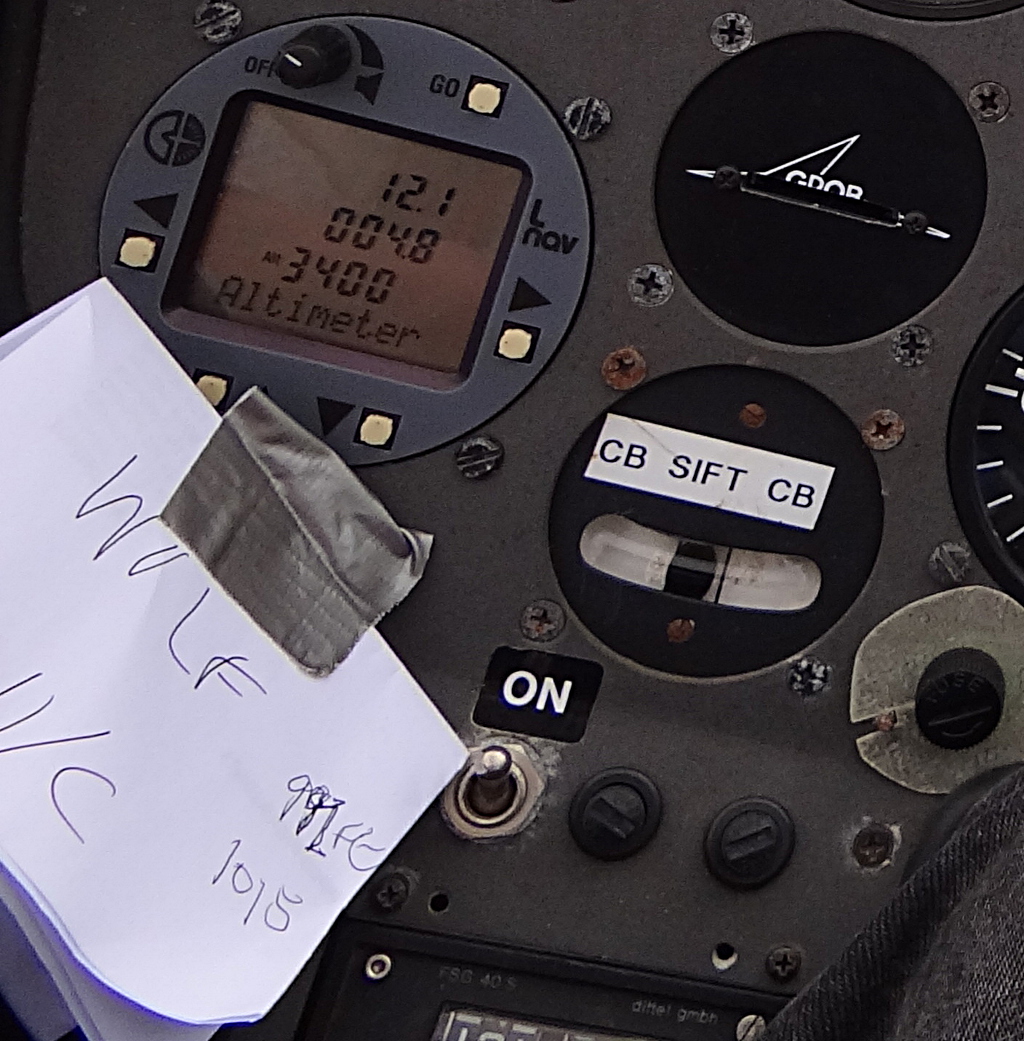
WULF, U/C, plus the QFE and QNH pressure settings.

What I did remember to do was stick a piece of paper on the instrument binnacle to remind me about lowering the undercarriage before landing. In this case there are apparently two sorts of pilot, those who have landed with the undercarriage up, and those who have not – yet.

The first launch of my day was off the winch and I only got to 1200 feet. It looks like I need to talk to an instructor to get some tips. Although I did connect to some very weak lift I decided to go off in search of better air and failed miserably to keep flying – I came down within 8 mins! Later in the bar I was roundly ridiculed by a fellow member of similar ability because I did not stay in the weak lift – fighting to climb away from the winch for half an hour like he did. So…

Lesson 1 of the Day:
Must try try harder from winch launches and not give up so soon.

Not that I am worried about my credibility in the bar you understand!

Due to a delay with the winch queue, for the next flight I decided to take an aerotow up to 2500ft which enabled me to learn the foibles of SH7 and also find decent lift. Not only was there some good lift, but there was also a copious amount of fast sinking air. I have not previously experienced such extensive downdrafts as strong as these – you rejoice on climbing up 500ft, which can be a struggle, and then to lose it in 1 minute because you hit some fast sinking air is depressing both psychologically as well as in height terms. However I did manage a 2 hour flight this time.


If you don’t know what QNH and QFE stand for I have put an explanation at the bottom of this post.

12:25 : Lasham from around 3500ft.

12:26 : Picture taken towards Odiham of a "working" sky.

12:27 : 400ft/min going down. Ouch. Struggling to find the lift.


Today was an object lesson about how thermals are not always circular. We get all this training about how to circle in a rising bubble of air, trying to centre in it properly, but now I am finding that the lift is anything but circular.

Lesson 2 of the Day:
Lift is not always circular.

The best time of the flight came when I spotted some seagulls as I was circling in some mediocre lift. As there were no gliders nearby I decided to try and circle underneath the birds. There have been a few other times when I have managed to do this and I always find it to be a wonderful experience. This time I found that in order to follow the seagulls my circles were very irregular, however I did manage to stay in the lift and gained some useful height. Unfortunately this only lasted for a short while before the seagulls disappeared, but it still felt great to be “flying with the birds”.

Lesson 3 of the Day:
Birds are smaller and more manoeuvrable than gliders and you cannot keep up with them.

After the flight it was a landing further into the airfield (called landing “long”), to park up by the hangar for cleaning duty. After this was done I helped the other early rising club member from the 8am ballot to de-rig the Discus. I was anxious to help out since I need to learn how to do this myself. Luckily it was not too hard, but will need someone to help. I am hoping to talk more about these lovely looking gliders later on in my flying development, once I am cleared to fly them. Hopefully before the end of the year.

14:15 : SH7 retractable Astir cleaned up before being packed back into the hangar.


Shot of SH7's cockpit after the flight.


Explanation: Cockpit Contents.

You can see here a shot of the roomy interior showing the items I usually take.

Items going clockwise from the bottom centre, including the easily visible control levers, are:

– One parachute – of course. Only the best dressed pilots have one, it does wonders for the look of your trousers when walking around outside the aircraft!
– One bottle of weak elderflower drink. I can’t stand having just water so I always add a bit of taste in, which also seems to help stop leaching salts out of me. My medical knowledge on this may be suspect, but I do notice the difference. One of my next todo items is to get a backpack drink system because it is too much faff to get the bottle out while you are trying to chase seagulls in a glider!
– One aviation map. Due to force of habit I always carry this with me, even when going for local flights. I also like to have the latest MemoryMap map in my phone since they do the proper aviation maps and it is always good to get confirmation by GPS, although I don’t rely on it.
– Green Trim Lever.
– Blue Airbrake Lever.
– Yellow Cable Release Handle.
– Joystick. Definitely need one of these.
– Silver Undercarriage Retract Lever. Forward all the way for down.
– Red Emergency Canopy Release Lever.
– One handheld radio as a spare. Always good to have a spare radio in case there are problems with the on board setup, say like a flat battery. Though the on board radio is going to be more powerful than my handheld one. From this you can start to get the idea that I might be a control freak!
– Microphone for the on board radio.


YOUTH EVENING TIME


After my day of flying, it was time to get ready for the youngsters turning up for their evening training. So back to the clubhouse for a scone and a cuppa and then over to the launch point.

As you can see from the first of the following photographs, it turned out to be a beautiful evening. There was plenty of enthusiastic help to run the launch point and we even had enough winch drivers to have both winches working, so our launch rate was prodigious! We had a total of 40 launches done before the end of the day – many thanks and well done to all the youth, parents and instructors who helped.

Then later, as usually happens, one of the instructors starts touting for ballast – sorry passengers – towards the end of the evening to see who wants to come and partake of some aerobatics in a K21. There is never a shortage of takers.

In a future post I will use the winch photographs to help describe how we handle bringing the cable back from the winches to the launch point.

19:33 : A silver lining in the evening.

20:02 : Picture showing the twin winch operation of the evening youth group.

20:16 : John can never resist the late evening aerobatics before putting the K21 away.


Altimeter in SH7 showing a height of 2760ft.
Pressure setting is mid-right of image and is set to 992, the QFE at Lasham.
Adjustment knob is bottom left of image.


Explanation: QFE and QNH Pressure Settings.
The abbreviations in the caption of the previous photograph are part of the Q Code from the early days of radio. Although I will not go deeply into the subject here I just want to highlight that the Altimeter in an aircraft is simply a barometer that measures the ambient air pressure. As you go higher the air pressure falls because the air gets thinner. This happens in a regular way so that it is possible to make such an instrument that usefully shows you your height – certainly at the altitudes recreational pilots usually fly. The altimeter has a knob to set the reference pressure setting at which it will indicate zero feet. That is what is shown bottom left of the altimeter photo here and you can see that it is calibrated up to 20000ft. The altimeter pressure setting is in millibars, where 1000 millibars is 1 bar, about 14.5psi.

Just in case you get confused about the usage of words like height or altitude, they have specific meanings in aviation. Height is how high you are above the ground, and Altitude is how high you are above sea level, and I will use these meanings in the rest of this explanation.

For the altimeter to show you your height, you need to set the reference air pressure at the reference point on the ground. This is where the Q code word QFE is used. “FE” stands for “Field Elevation”, i.e. the altitude of the airfield, and the QFE is the pressure setting at this altitude. By setting your glider’s altimeter to this pressure setting it will show you how high you are above the airfield. Just what you want for local flying.

You can also do it the other way around which is what I do before launch. I set the altimeter to read zero feet while on the ground and then I read off the pressure setting, which is the QFE figure. This is the first figure I write on my piece of paper.

So what is QNH? Here “NH” stands for “Nautical Height” and, as you might guess, is the pressure setting at sea level. If you set the altimeter to the QNH setting, it will give you the altitude of the aircraft above sea level. If I know the altitude of the airfield above sea level – for example Lasham is 620ft – all I have to do is adjust the pressure setting knob until the altimeter shows 620ft, and then read off the pressure setting. This will be the QNH and is the second number I write on my piece of paper.

Measuring the pressure settings when the aircraft is on the ground is a good idea, because when I am flying I can then adjust the altimeter pressure setting to those numbers without having to think too hard and the altimeter will show how high I am above the ground if set to QFE, and will show how high I am above sea level if set to the QNH.

I need to know these numbers because the aviation maps will usually show altitudes of not just ground features, but also airspace. Another set of numbers the map shows are “Flight Levels”, but that is for another time because my brain hurts and I bet yours does too. If you get a chance to go flying ask your instructor to allow you to play with the altimeter setting and explain to you what is going on.

Suffice it to say that before every flight I fiddle around with the altimeter and write down both the QFE (Field Elevation) and QNH (Nautical Height) pressure settings. If I am not at Lasham my aviation map will show me the altitudes of all the airfields so I can easily find out the QNH.

21:38 : Glider tucked up in bed for the night. The next day was going to be really good - but I wouldn't be there. Shame.


All in all a long day for yours truly from 8am to 9:30pm, but once again a very rewarding and content feeling as, back at home, my head hit the pillow and I went straight off to sleep.

Night night, sleep tight…

GLIDER CHRONICLES 2011 – July 3rd : Cheap Winch, Expensive Aerotow

A day that showed how quickly the air changes. As you can see from the early morning photo, the sky started off clear and blue and I had time to get SH9 out and give her a good clean. Needless to say the sunny conditions gave me that lovely morning anticipatory feeling of a great day to come.

A pristine SH9 (Grob 102) ready at 10am to be towed out to the launch point.
Notice the clear blue morning sky.


By the time we had the gliders at the launch point I could see the clouds building very quickly to the north. I decided it was time to get going – NOW! – since it was forecast to become overcast later in the day and conditions seemed to be changing faster than expected.

My first, and best, flight of the day was from the winch. I got launched at 11:45 just as the main grid of gliders was launching so I knew it was going to get busy. It duly did and I consistently found that the Baby Grob could turn tighter and fly slower than most of the other gliders I was thermalling with. Great for climbing but not so great for glider avoidance! There were a number of times when I left a thermal only to return a few minutes later when the other gliders had climbed higher and were out of my way. I am also starting to realise that I will tend to leave a thermal earlier just so I can get some clear sky! Never realised I was so antisocial.

12:30 : Well banked 45deg turn at 4000ft and still going up at 250ft/min.
For once have got the string in the middle!

12:34 : Photographs rarely do justice to the beautiful skies that you see when gliding.
Couple that with their proximity and you can be forgiven for taking too many cloud pictures.


All the flying shots from today are from that first flight which lasted 1 hour 47 mins. A cheap launch for a lovely flight. As the caption to the last picture says, you must forgive me for showing cloudscapes. The 2 shots above were culled from 11 originals! It is an uncommon occurrence for most of us to be in the sky and it still fills me with wonder on every flight – without fail. Despite my flight training, my scientific knowledge of the physics, and my engineering background, I am still drawn to seeing the sky as a wondrous, living thing. Words will fail me when I experience it and I will just find myself laughing in flight at the sheer joy I feel.

13:03 : A rare well focussed shot of Alton.
Also you can see the dead flies accumulating on the leading edge of the wing.


Another thing I have found surprising is the number of dead flies the glider catches on its wing. The frontal wing section is not large and as yet I have not being flying fast so it can only mean that when you get into a thermal you are flying through a veritable cloud of insects. Hmmmm. Memo to self: Do not open mouth when flying an open cockpit glider! It is worth clicking on the above shot and zooming it to full size so see the number accumulating on the wing.

By the time I was getting to Alton the conditions were noticeably deteriorating with the cloud becoming completely overcast but I did manage to find some fires and played with the meagre lift they generated. I found the lift area fairly small since none of them had triggered off a larger thermal.

Another factor that meant I would need to end the flight soon was the increasing volume of the call of nature which was fast becoming the “SHOUT of nature”. It is definitely time to start thinking about “in-flight plumbing” as the BGA shop calls it. This is a purchase I have been putting off and will need to get sorted out when it comes time to do my cross-country flying.

13:20 : Back down on the ground under a dreary sky.


After that wonderful first flight I decided to take an aerotow to see what the conditions were like. Obviously proving I had more money than sense, though the flying bill is looking decidedly nasty this year. I managed to find 1 knot lift over Basingstoke that eventually just petered out so the flight lasted only 32 mins.

So let me get this straight. I paid around £8 for a winch launch and got a flight of 1:47, then I paid about £40 for an aerotow and got a flight of 32mins? What was I doing?

Well at least I learnt more about cleaning flies from a glider wing.

Until the next time…

GLIDER CHRONICLES 2011 – June 30th : In the Calm of the Evening

A short posting here about an unexpected end to a normal working Thursday. My Sony HX100 camera was new and gleaming and just waiting to be taken out for a spin! So I popped down to the flying club to see what shots I could get and – in all seriousness, honest – do some test shots with different settings.

The unexpected occurred because as soon as I got to the launch point, one of the K21 gliders was free and I was asked if I wanted to fly it. I initially demurred, saying that I had not “got my head into it” since I had not prepared myself mentally for flying. I have now realised that I usually plan my flying at least 24 hours ahead and so mentally rehearse the prospective activity. However this time it took me about 20 minutes to get my brain up to speed and realise that – Yes! – I would love to go flying, even for a couple of short circuits.

The next unexpected thing that occurred is that a fellow club member offered to take some shots and he created some beautiful ones that I have now had printed and framed. I don’t know his name but he obviously knew what he was doing – so many thanks to you, mystery photographer – whoever you are.

Shots from the evening follow with some of me for a change – so get yourselves ready since I am not very photogenic.

This first shot was me playing around with the camera at high zoom (30x) and pleased with the result. If you zoom in you should be able to see the detail of how the cable attaches to the glider. A shot that was helped a lot by the camera’s image stabilisation.

Distance shot of K13 on launch. You can see detail of how cable attaches. Bottom right is the folded parachute.


In this next shot you can see the “retrieve truck” with the two cables attached behind. If you zoom in and look carefully you can see where the cables are crossing the small runway behind the truck.

Retrieve truck pulling back the 2 cables from the winch.


Explanation : Retrieve Truck.
The Winch has 2 large cable drums each with at least one mile of steel cable so they are heavy and have to spin down slowly. After both cables have been used to launch the gliders the Retrieve Truck goes back to the Winch and the driver hooks both cables onto either side at the rear where there are special attachments. It then slowly pulls away and drags the cables back to the launch point – all in second gear – at no more than 25 to 30mph.

During the journey back to the launch point there must be no gear changes or sudden speed changes because the cable drums can overrun and cause a birds nest at the winch. Big direction changes are also out otherwise the cables can cross each other. Other folk need to give the truck a wide berth to make sure that nothing gets in its way, since it is the winch that controls the braking, again to stop the drums overrunning.

The truck driver has to slowly reduce speed as they get to the launch point which signals to the winch driver that they are about to stop – then s/he can just drop the clutch, letting the winch pull the truck to a stop. S/he should then keep the brakes off until the cable has pulled the truck back even further, thus releasing the tension. That way the person detaching the cables from the truck doesn’t risk getting hurt by any “ping back” of the cable as it is released from the truck.

The next set of 4 photographs were taken by the “mystery photographer” and you can see the difference. I particularly like the second one. It is notable that I have not done any colour processing or cropping of it. I have just reduced the resolution for the web.

As is usual at this time of day, the evening air was very smooth and calm, which fostered a quiet and reflective mood. Though no lift was present, it was still memorable because of this graceful peace which gave me a sense of completeness about the flying. A definite breathing out after the hiatus of the workaday.

Ken looking bored on the wing while waiting for me to launch. Notice the lensing of the trees in the rear canopy.
Time for me to have a new haircut!

Lovely shot taken by a fellow unknown club member. I am gently bringing the glider into the full climb.

Second shot of me further up the winch launch into the full climb.

Almost full airbrake coming into land.


Later in the evening we had this following example of an old motor glider from the 60s. Basically a single seat Slingsby T31 with a VW 1600cc engine on the front. Cheap flying.

Slingsby T31 Motor Tutor.


And then later in the evening there was a beautiful sunset. A lovely ending to a workday evening filled with pleasant surprises.

Evenin’ All…