GLIDER CHRONICLES 2011 – May 31st : Loads of Fluffies

Well this day was marked by a number of points. First it was a Lasham Regionals Competition day as remarked on in my previous post.

Second, I had Jim, one of the first gliding instructors I had at Lasham. Not so remarkable you say? Well, no, except for the fact that it was 30 years ago! I showed him my logbook entry with his signature from 22nd May 1981. Needless to say he was horrified, mainly about the passage of time I believe, hopefully not my flying performance.

Weatherwise it was a lovely day with beautiful fluffy cumulus clouds like in the following pic. By the way that is a technical term of course. i.e. Fluffy, not Cumulus… Silly!
🙂 (Update: See a favourite clip of mine from the film “Despicable Me” – “Its so fluffy!”)
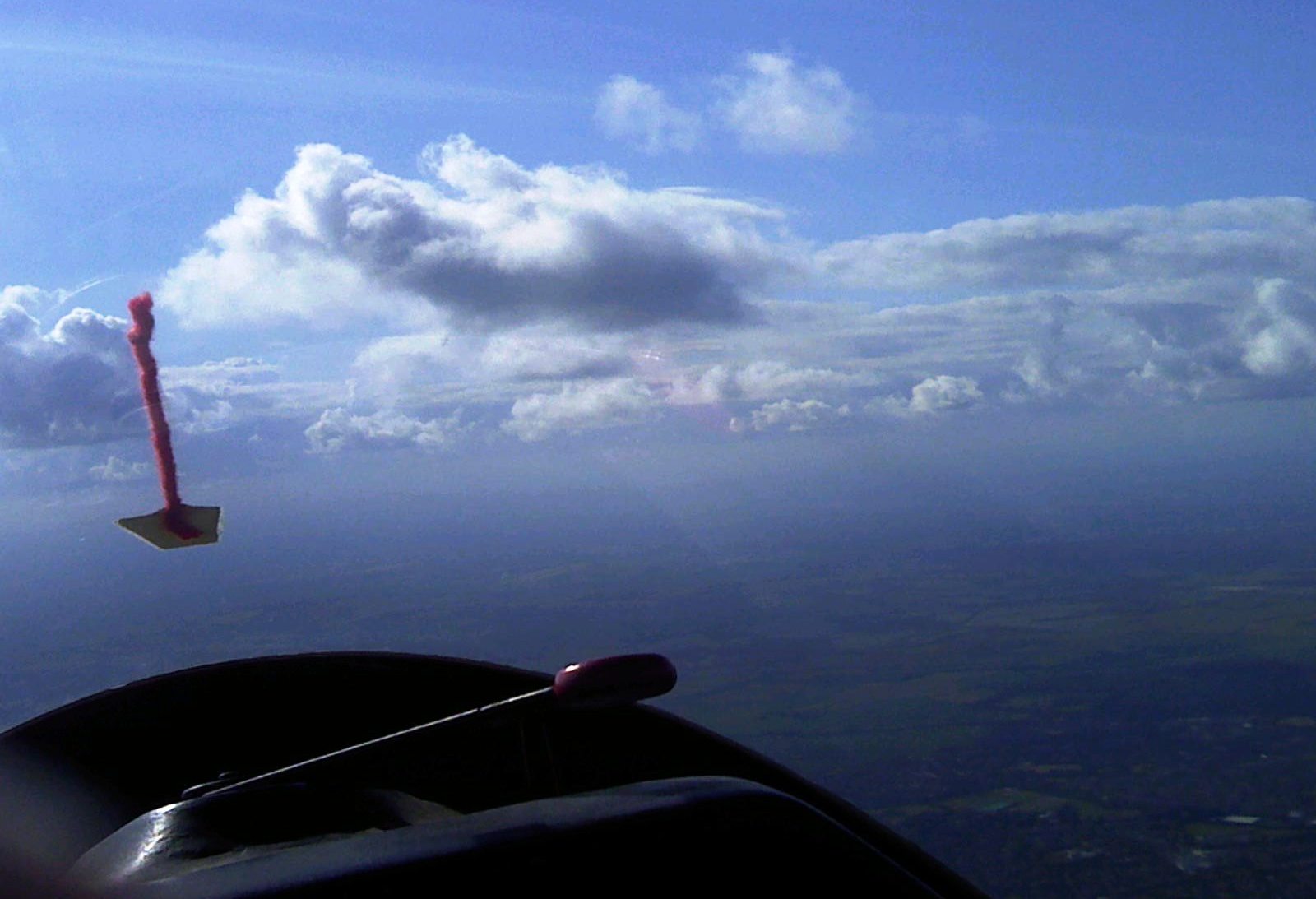
Fluffies!

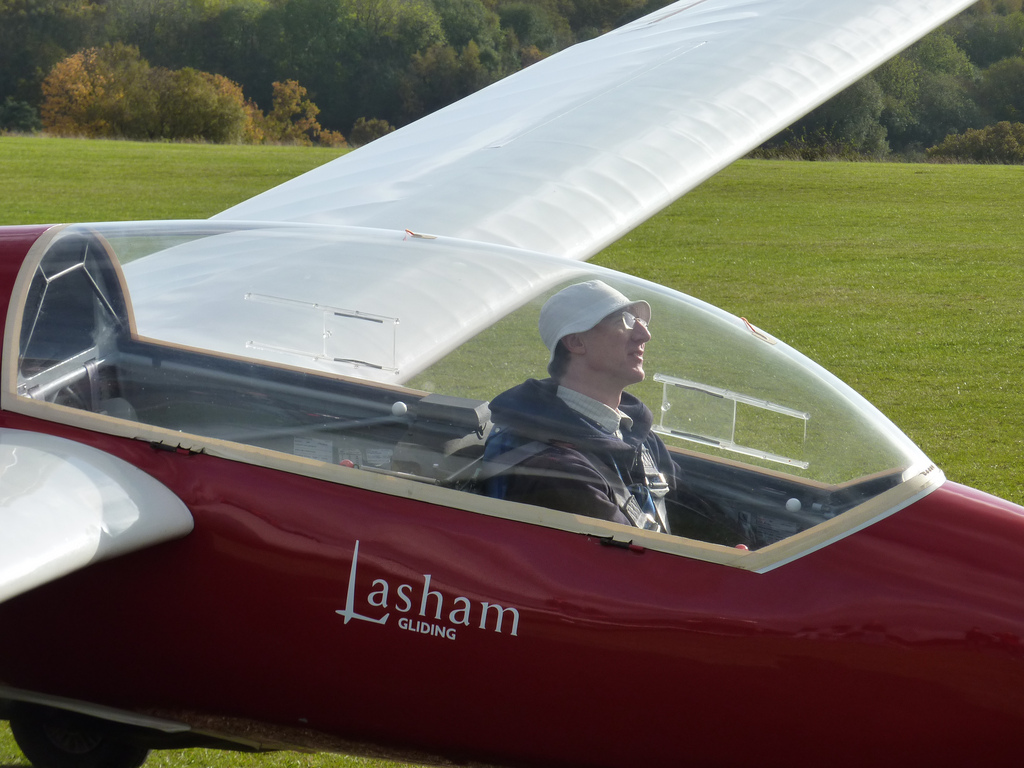
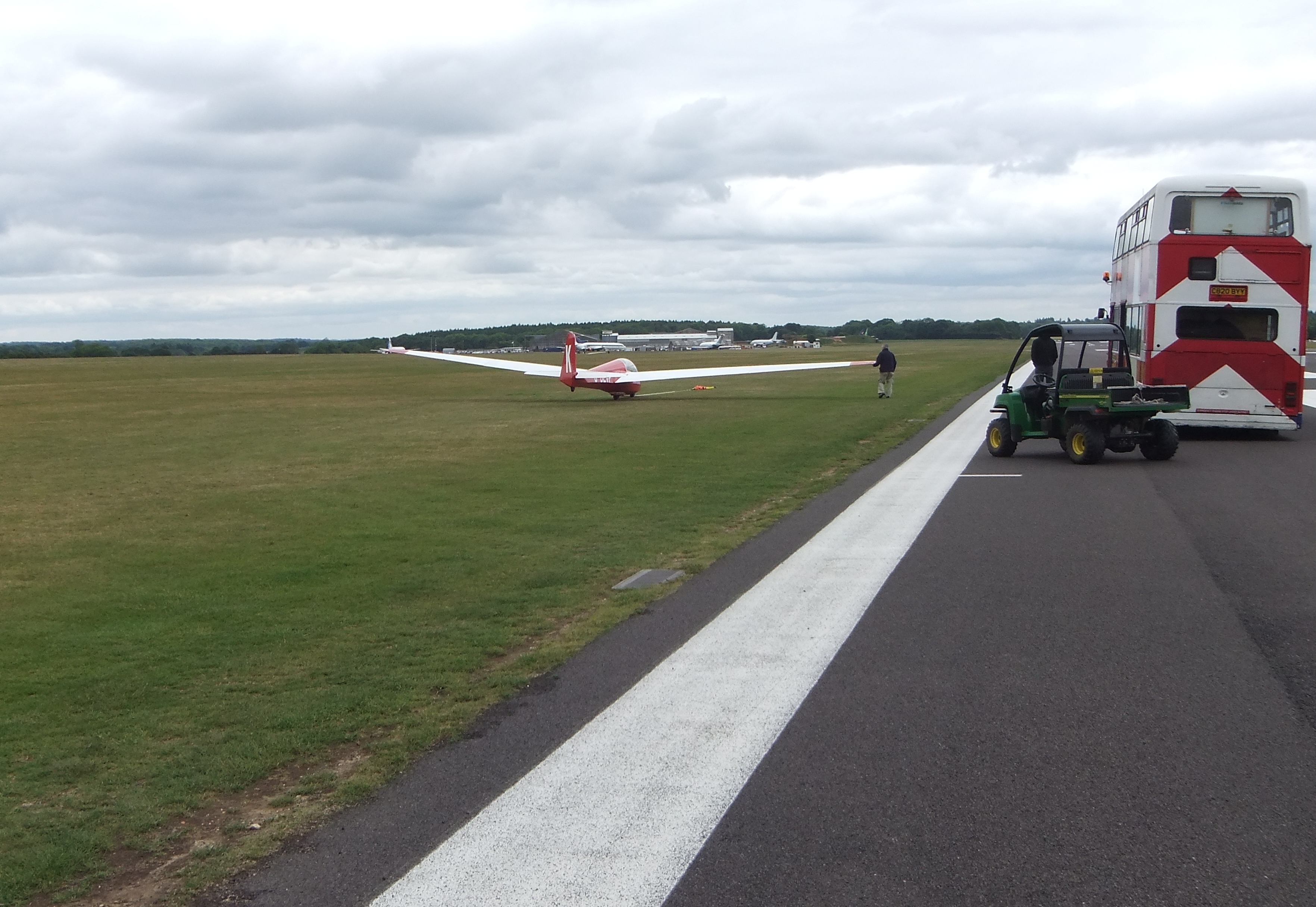
However that shot was from later in the day. The first flight of the day was with Jim in the K21, number 431 and, unbeknownst to me, involved him asking the winch person for a simulated power failure. Since I was trying my best to narrate my way up the launch, describing what I was doing and why, the failure occurred while I was talking. Needless to say I shut up immediately as the load of dealing with the launch failure took over my thinking. Of course, being a man, I can only do one thing at a time.

Once we had landed safely down at the side of the winch, and having used full airbrake, yet releasing it slightly just before landing, Jim was happy for me to go off flying solo.

Explanation of Airbrake/Wheelbrake Interaction on 431
As with a number of other gliders, the airbrakes are connected to the wheelbrakes in such a way that when you pull on full airbrakes, it engages the wheelbrake. Useful for precision landings and the like. However it is important not to land initially with the wheelbrakes on, otherwise surprise and possible damage ensue. You need to allow the wheel to rotate freely as you contact the ground, then apply the wheelbrake as required during the landing run.

The current target was to convert to flying the single seater. I had done all the necessary exercises, but needed another 3 solo flights to get to the 20 required for the conversion. I was being very honest and not counting the 6 I had done way back in 2009, let alone the 29 I had done way way back in 1987/88!

And so… today I needed to do 3 solos in the K21. No problem! I can get those over and done with in a blink of a gnats eye. (Do gnats actually blink? Hmmm. Don’t think so)

Back to the winch launch point – a mile long walk from where we had landed! Get the glider lined up. Secure the harnesses and the canopy of the instructors seat. A nice launch to 1800 feet followed by a bimbling search for some lift. Got down to 1300 feet before managing to connect to rising air. Only 2 knots up initially, but that will do.

Explanation of ‘knots up/down’
Glider pilots, when talking about the amount of lift or sink, usually use knots. 1 knot is 1 nautical mile per hour. 1 nautical mile is 6076 ft. So 1 knot is 6076 / 60 feet per minute, i.e. 101.266r, or roughly 100 ft per minute. “2 knots up” is therefore used to mean “200 ft per minute lift”. Of course on the continent they use the metric measure of metres per second and 1 knot is roughly equal to 0.5 metres per second.

Here is the shot of the glider rising at 400 ft per minute, or 4 knots up.

VSI at 4 up.

In the end I managed to get all the way up to 4500 ft. Words really cannot do justice to describing just how elated one feels after such a climb. For a beginner like myself it can be such a struggle to do this that it usually ends up with me shouting with elation. The only other experience like it is when skiing and you look back up at the mountainside down which you have journeyed.

In the end the lift was so strong that I had to use my airbrakes in order to stay below the airway above Lasham and it was fast becoming clear that this would not be a short flight. However you might remember it was a competition day and at the 1 hour 40 minutes mark I heard the first competition glider returning. A mini-panic ensued because I did not want to get caught in the flurry of fast competition landings with gliders coming from every direction at once.

So I rushed back to Lasham using lots of airbrake and landed then parked the glider so I could go over and see how the youth gliders had done. The following photo is of the road from Basingstoke leading to Lasham, which is top left of the shot.

The road from Basingstoke to Lasham, going through Herriard.

The last of the competition gliders had landed and I belatedly remembered I needed to do another 2 solos! So time to rush back to the glider and take an aerotow for yet another fairly long flight of 67 minutes managing to get a distant shot of Basingstoke.

Basingstoke - Doughnut City with more Fluffies.

After returning to land I followed this up with a short winch launched flight to take me up to my 20 solos.

All in all a wonderful soaring day with 3 hours of flying and achieving the 20 solo target. Weather permitting, moving on to the single-seater will hopefully be the subject of my next post…
GLIDER CHRONICLES 2011 – May 31st : Competition Day

This week is competition week at Lasham. After a miserable weekend the sun came out on Tuesday to allow the competition to have its first day of flying. Although it was a sunny day the competitors were surprised by a hailstone shower coming across the airfield right in the middle of launching the gliders.

[Note that all pictures in this post are just the right eye of a stereo shot. Under each photo I will link to the left hand eye so that those who wish to do so, can mess around and make themselves a stereo shot. Be aware that this is a very photo intensive post, but then pics are always nice to have.]

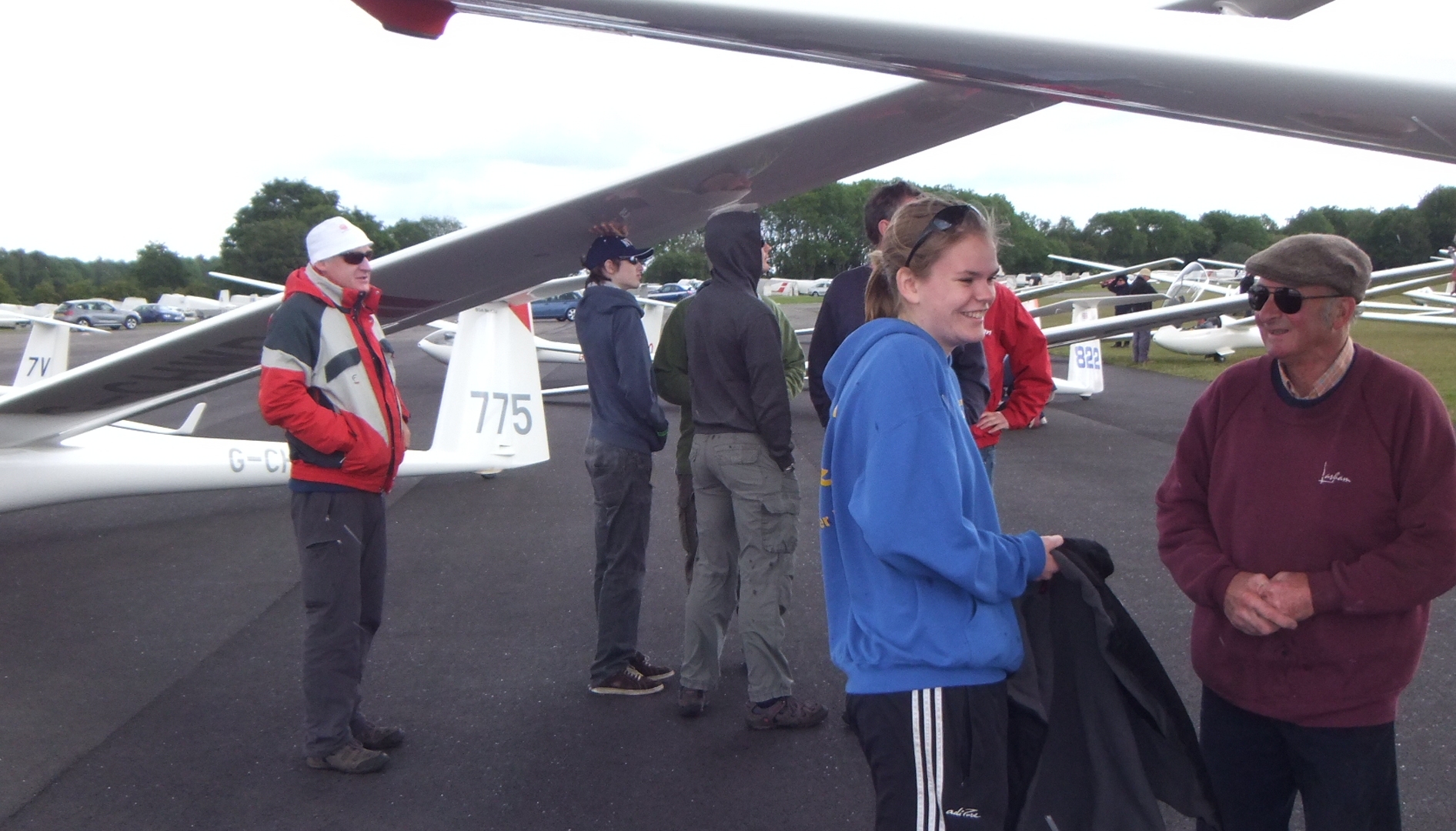
Some pilots sheltering under a glider wing during the hailstorm. Notice the high fashion parachutistas! As well as the beanie hat brigade.

[Left eye shot here]

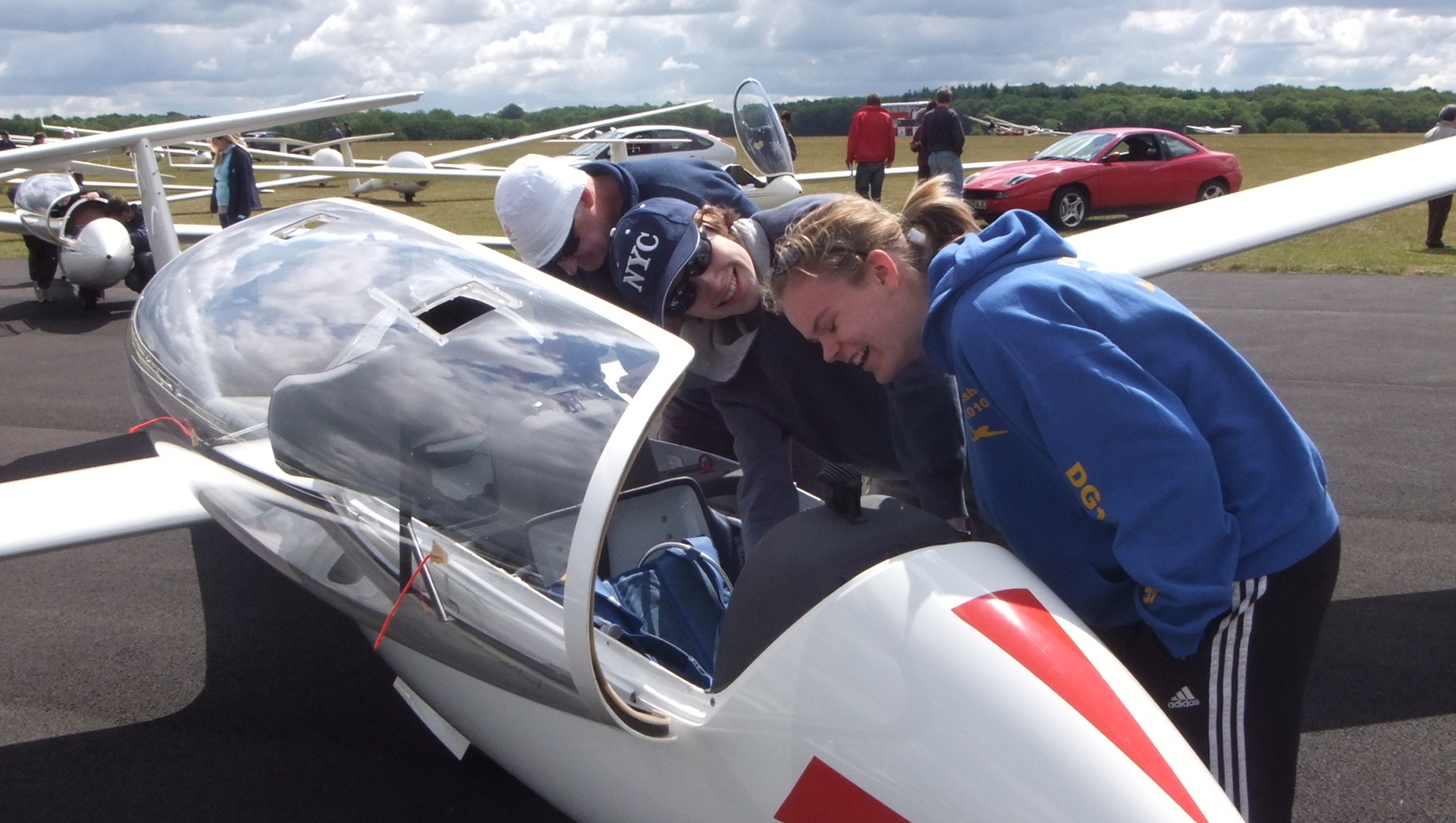
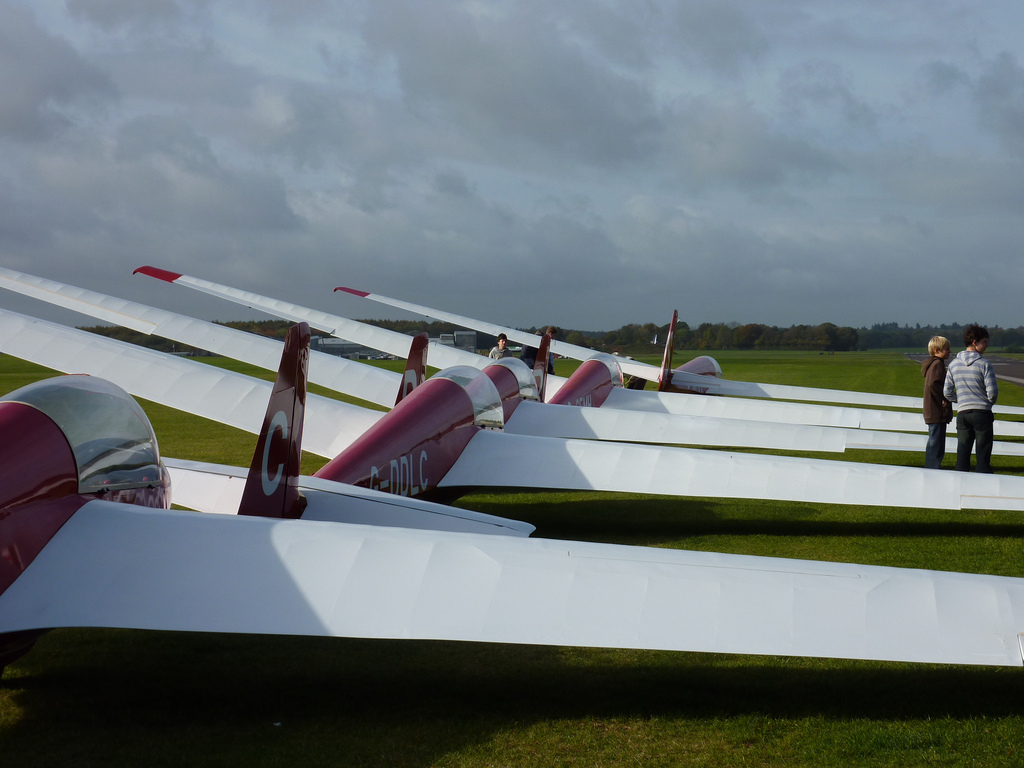
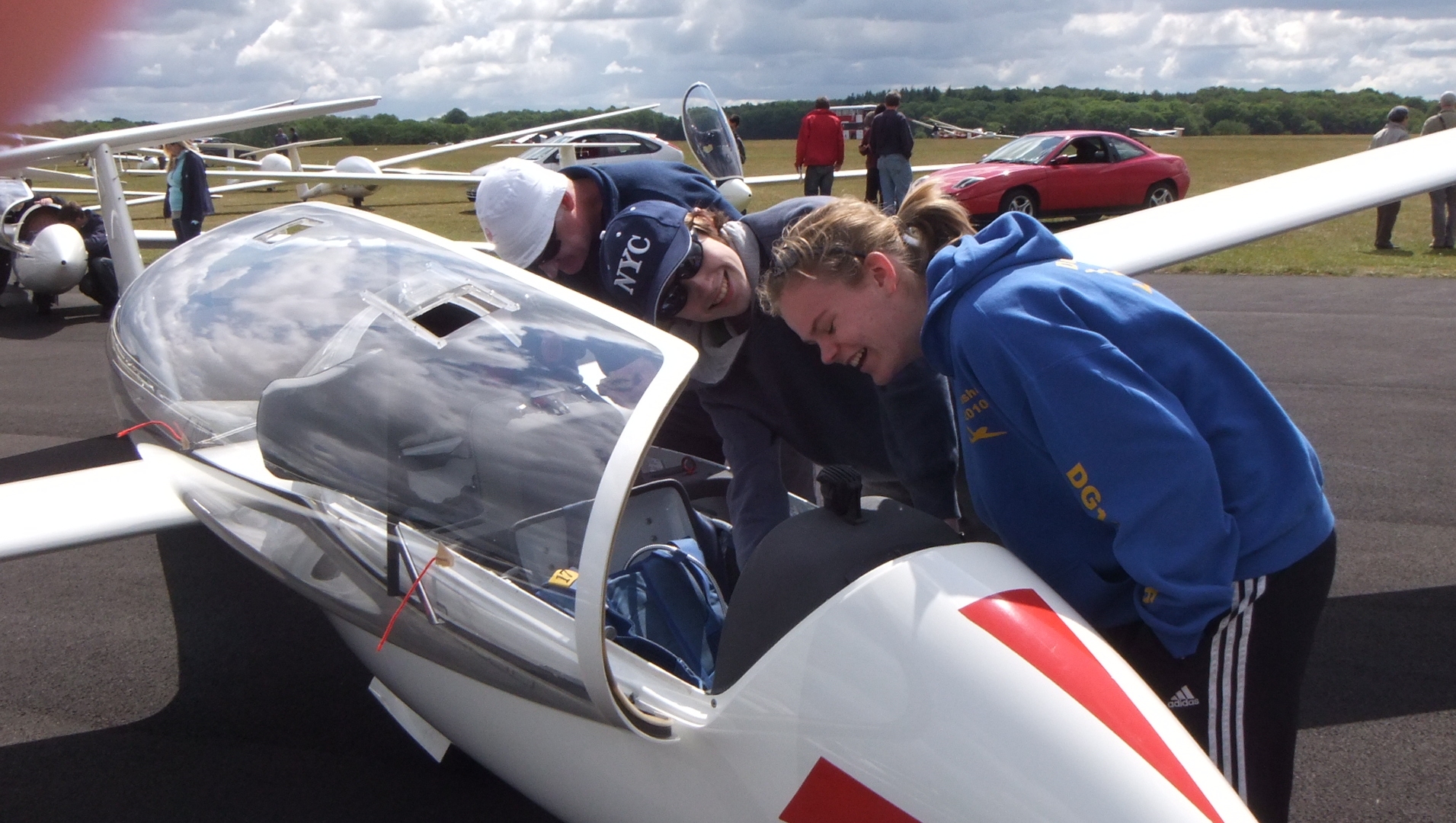
Although not taking part in the competition I did manage to fly that day which will be in a following post. However below are some pictures from the competition launch point taken when I took a break from normal club operations to go and help some of the Saturday evening youth flyers getting ready for the off. Dave, the organising instructor from the Saturday evenings, had arranged for two twin-seater gliders to be flown in the competition with a youth member.

The Yoof Gliders

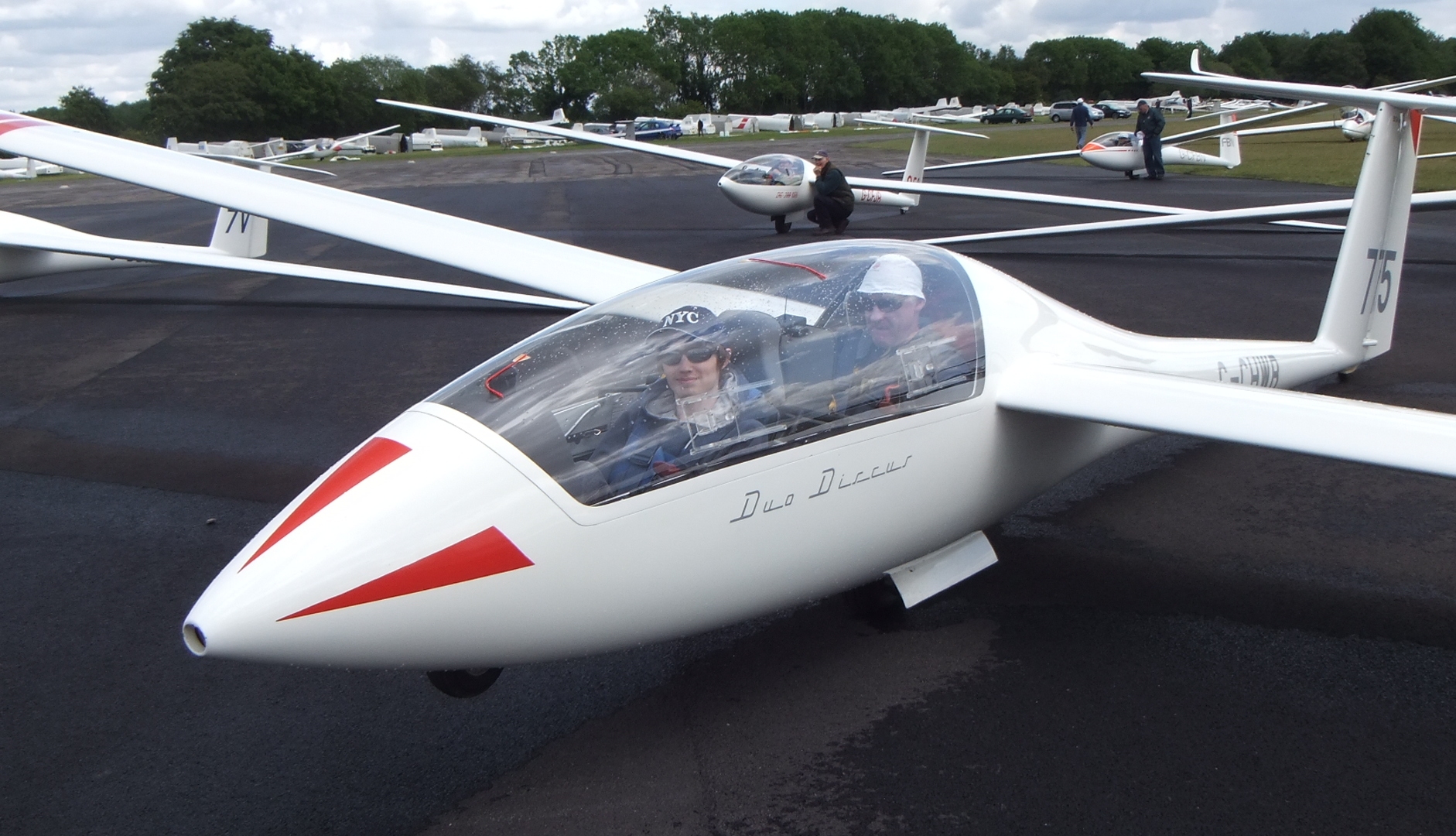
So first up is glider number 775 flown by our beloved CFI (Chief Flying Instructor) Colin with Alex (nowadays cleared for solo) as his second-in-command. The glider is a Duo Discus.

Alex in the front with Colin the back waiting for the aerotow.

[Left eye shot here]

In the other glider, number 778, we had the intrepid and hard working yet eccentric Dave, with Sarah as his second-in-command. Sarah also is solo and has defected to the military for her flying training, intending to be a commercial pilot one day. The glider is an ASK21.

Dave in the front with Sarah looking cool in the back.

[Left eye shot here]

Task du Jour and how they did

The flying task set was to fly 272.8km (very important the “point eight” according to Sarah), from Lasham via Newbury and then up to Silverstone. The return journey required coming back to Lasham via Andover.

Colin and Alex managed to make it all the way round with Alex remarking on landing that his feet had been cold. Yes Alex, that happens when you’re flying near cloudbase! Unfortunately David and Sarah needed an extra launch or two and finished the day by landing out at Popham. They then got an aerotow from Popham that allowed them to fly back to Lasham.

From the smiles on Alex and Sarah’s faces you could tell that great fun was had by all.

More Photos

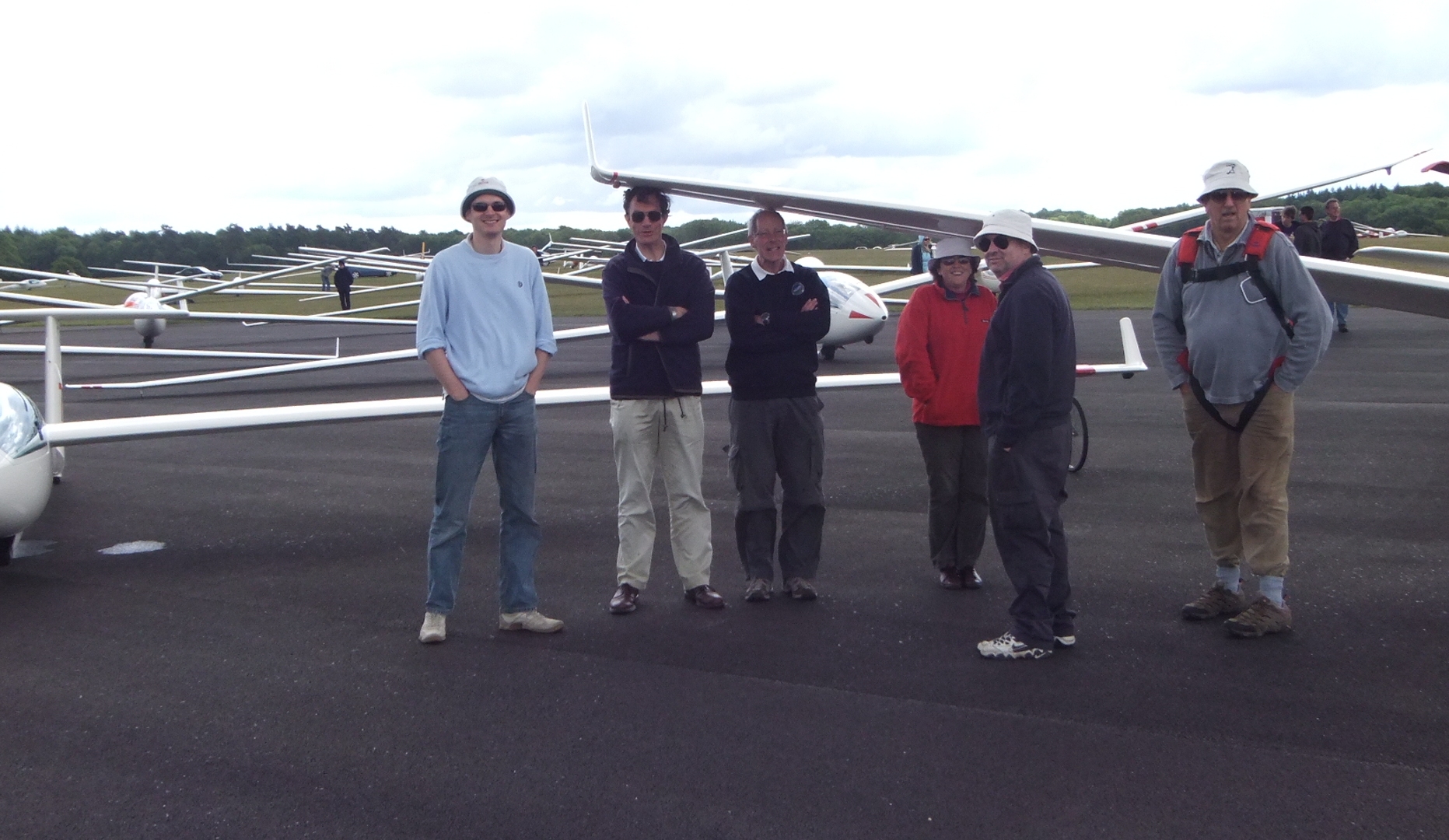
Colin, Alex, Sarah and Dave sheltering under wings until the rain and hail pass.

[Left eye shot here]

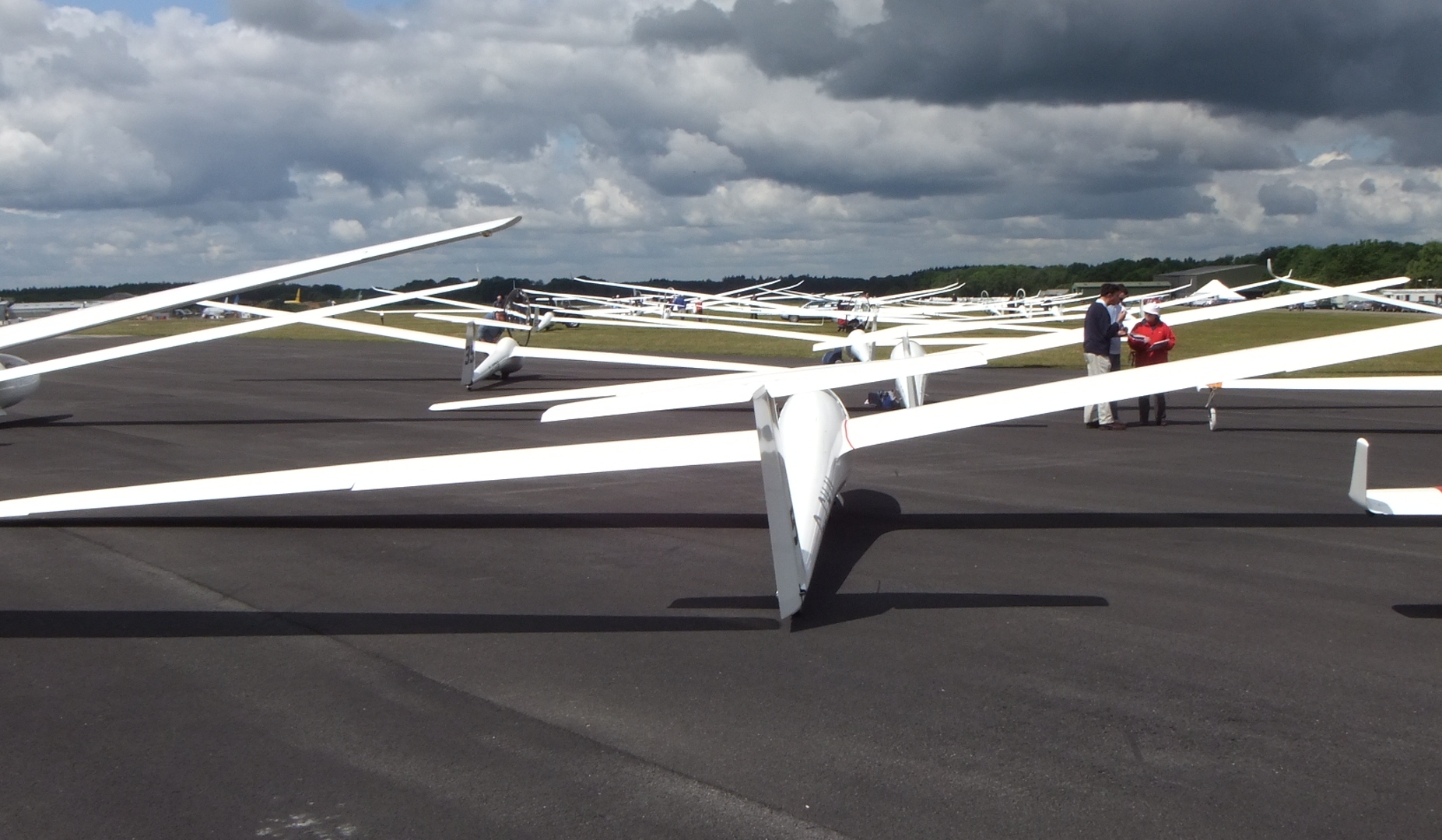
The competition grid in front of the youth gliders.

[Left eye shot here] The full grid of both the ‘A’ class and ‘B’ class contains about 60 gliders.

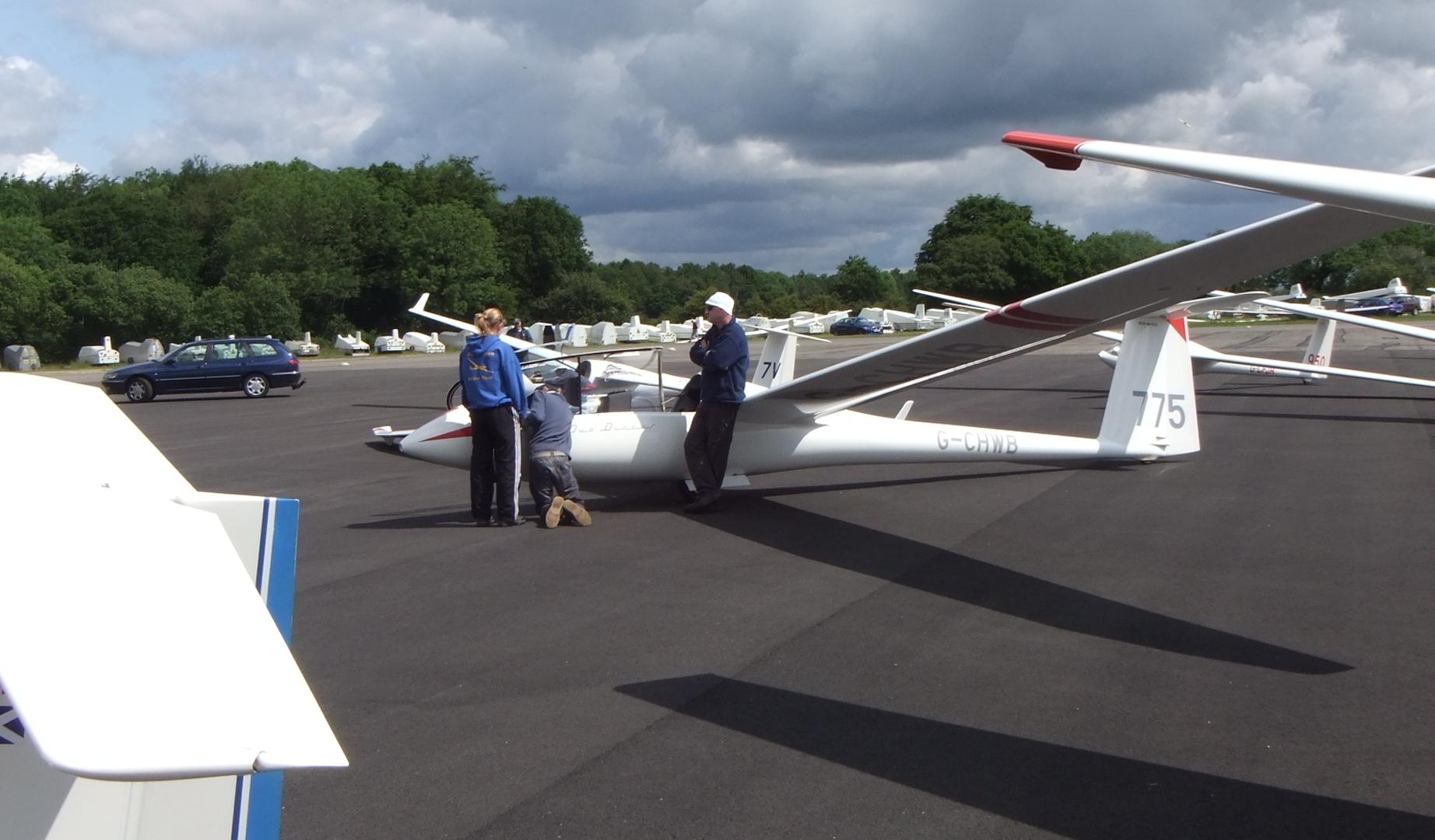
Sarah watches, Alex gets his cockpit ready and Colin relaxes!

[Left eye shot here] Of course it is so important to get that cushion just right. Although I do believe Alex was trying to work the ClearNav system.

Sarah and Alex doing tech setting up the GPS-based navigation system for the task.

[Left eye shot here] For the tech-heads among us the nav system is a ClearNav flight computer.

GLIDER CHRONICLES 2011 – May 27th : Fire Thermal & Solo Aerotow.

This day had a surprising morning soaring flight in overcast conditions thanks to a bonfire on a farm, plus a couple of solo aerotow flights, representing a significant milestone on the way to being able to fly the single-seater glider fleet.

To give an idea of the cloud cover here is a picture – though taken 2 days later on the Sunday but with similar conditions.

K13 Launch on a cloudy day.

Fri 27th May: Conditions: Moderate cross wind from the north-west.

Instructor notes 1:

  • Check flights in K21. Run out of height + (winch) power failure well handled. Cleared for solo in crosswind conditions.
  • This was followed by 3 solo flights from the winch in overcast conditions so no sun reaching the ground. However, someone on a farm had lit a fire which triggered off thermal activity thus allowing me on one of the flights to scratch around until I managed to find a 4kts up thermal which took me up to cloudbase at 2000ft. This resulted in a flight time of 31mins which was above the threshold of half an hour for counting as a soaring flight from the winch.

    So once again I was feeling very pleased with myself given that it was completely overcast. Also to add to the big headed feeling, I saw someone else get an aerotow above me into the same area around the fire. However they were not able to connect to any lift and thus had to land before me.

    Instructor notes 2:

  • Aerotow well flown including out-of-position and boxing the tow. 2 solo tows well handled.
  • By the end of the day, although there was now some sun, the lift was very weak indeed. However it was nice to carry out a couple of solo aerotows to get these under my belt.

    Explanation of Boxing the Tow
    This is an exercise that is used to show that you are proficient at handling the aircraft during an aerotow. (An aerotow is where the glider gets pulled along behind a powered light aircraft called the Tug)

    Boxing the tow involves first descending lower than the tug aircraft. This requires the pilot to control the glider as it passes through the turbulent air from the propeller of the tug (the propwash) until it reaches the calmer air below it. You then have to fly the aircraft out to one side and hold it a short while. Then, staying on that side, fly up to level with the tug aircraft or slightly higher and hold… Then fly across to the other side of the tug at the same relative height and hold… Then again staying out to the side, descend to a height below that of the propwash and, you guessed it, hold… Then return to the starting position below the propwash before returning to the normal tow position behind the tug.

    If you do this well you will have described a nice rectangular flight path around the tug’s propwash, hence the term: Boxing the Tow. Great fun.

    Next step is to move onto getting ready to fly the Grob102 single seater, also known as an Astir.

    Grob 102 picture from the Imperial College Gliding Club archive.

    Follow this link to the Imperial College Gliding Club archive to see the gliders that they have owned throughout the years.

    Coming up:
    Lasham Regionals Competition and flying log from the same wonderful day, once the weekend rain had passed.

    GLIDER CHRONICLES 2011 – May 21st : From Wood to Glass.

    No, not wedding anniversaries, but converting from flying wooden gliders to flying a glassfibre glider.

    Sat 21st May: Conditions: Strong south westerly.

    Instructor notes:

  • K21 conversion OK.
  • The K21 is a fibreglass glider and so is slippier in the air and needs a few adjustments to how it is flown compared to the wooden K13. It is used to get pilots ready for converting to flying the single seater Grob102 which is even slippier (apparently since as at this writing I have not flown it) and more “frisky”, shall we say.

    Since the wind was too gusty during the day, my instructor didn’t want me to fly it in the day, however the evening instructor was happy to allow it since the wind had died right down to calm.

    Personal notes:

  • Evening solo hangar flying the K21. Calm. Still found a little lift over the woods. Duration 8mins.
  • Interesting how the woods give off lift at the end of the day. Not much, but enough to scratch at for a short while, You don’t go up, but it is enough to stop the glider from descending in some areas.

    I am still getting used to this glider since it has a lot more what we call “adverse yaw” than the K13.

    Explanation of Adverse Yaw
    To explain adverse yaw I offer you this chance to exercise your inner child.

  • Put your arms out to the side like young children do when playing aeroplanes.
  • Then bank to the left.
  • At the same time turn your head to the left, towards your lower arm.
  • Yaw is what is happening with your head, and in this case is in the normal direction you would expect. Now assuming your inner child still has their arms out…

  • Bank to the left again.
  • This time turn your head to the RIGHT, towards your UPPER arm.
  • This is “adverse” yaw and with an aircraft only happens for a short while at the beginning of the turn. It happens because the wing which is going up, in this case your right hand, is asking for more lift than the left-hand. That is why the aircraft banks to the left. But asking for more lift from the wing produces more drag. So because the right wing has more drag than the left it goes more slowly, in this case twisting the aircraft to the right.

    When flying, to counteract this you have to put in more left hand rudder than normal, but only at the beginning of the turn.

    So… Now you, and your inner child, know about adverse yaw!

    OK. You can now give your inner child a rest.

    For those other thinkers out there, you will notice that the inner child’s experiential knowledge is different to the adult’s “head” knowledge. To properly experience this difference you must let your inner child play the game in reality. Go on, you can do it. so what if your family and/or friends and colleagues think you are crazy. It’s not you, it’s your inner child. 🙂

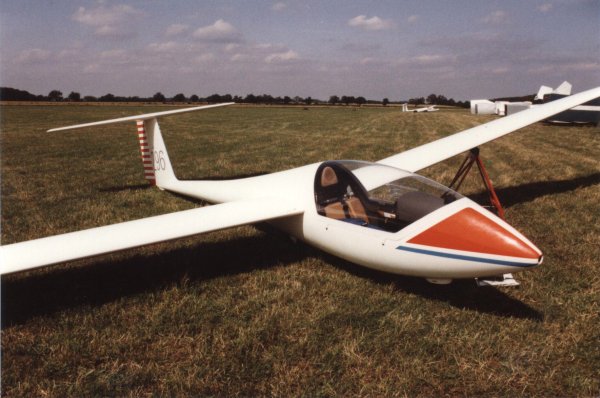
    The K21 in question.

    A reminder of the K13 wooden glider.

    Coming soon:

  • Thermalling above a fire…
  • Lasham Regionals Gliding competition, with more photos…
  • GLIDER CHRONICLES 2011 – May 13th : Friday – lucky for some.

    Not a time to be superstitious. I admit that some doubtful thoughts crossed my mind on the evening before, but by the time I was at the flying club, all that was forgotten and I just had a great day.

    The instructor this time was the guy who wrote the book about winch launching! So managed to get the real info on how to do it and the issues involved. This is one of the applications where the practical use of mathematics really comes to the fore. Why? Well, one aspect is that if you pull up into the main climb too fast you are trying to increase the vertical component of your speed too quickly, and guess what? This mistake can kill you! Hence all the training and training about it.

    Follow this link to some video simulations on the British Gliding Association (BGA) website. Suffice it to say that this safe winch launching drive have resulted in a significant reduction in accidents over the last 5 to 10 years. Good job.

    Fri 13th May: Conditions: South westerly. Gusty. Ragged soaring.

    Winch launch:

  • Look at BGA website re: launching.
  • No time to worry about getting onto main wheel since it all happens too fast. Just keep glider in a shallow climb until accelerating through 50kts. Look for 50kts on ASI and just feel for the acceleration in seat of pants.
  • Then gradually go into full climb over 3-4secs. Don’t change attitude too quickly. This can kill.
  • Use judgement in the moment, rather than relying on pre-thought out decisions.
  • Instructor notes:

  • Good winch launch. Running out of height exercise showed good judgement associated with safe handling. OK for solo.
  • Personal notes:

  • 4pm flight. Real tussle to stay up. Duration 1hr 1min.
  • Another great flight, but late in the day when the lift was dying since the sun is lower. Found a brown field (i.e. no crop) which was giving scrappy lift but, lift nonetheless. A real hard long fight as much as a flight. Still felt great after that accomplishment.

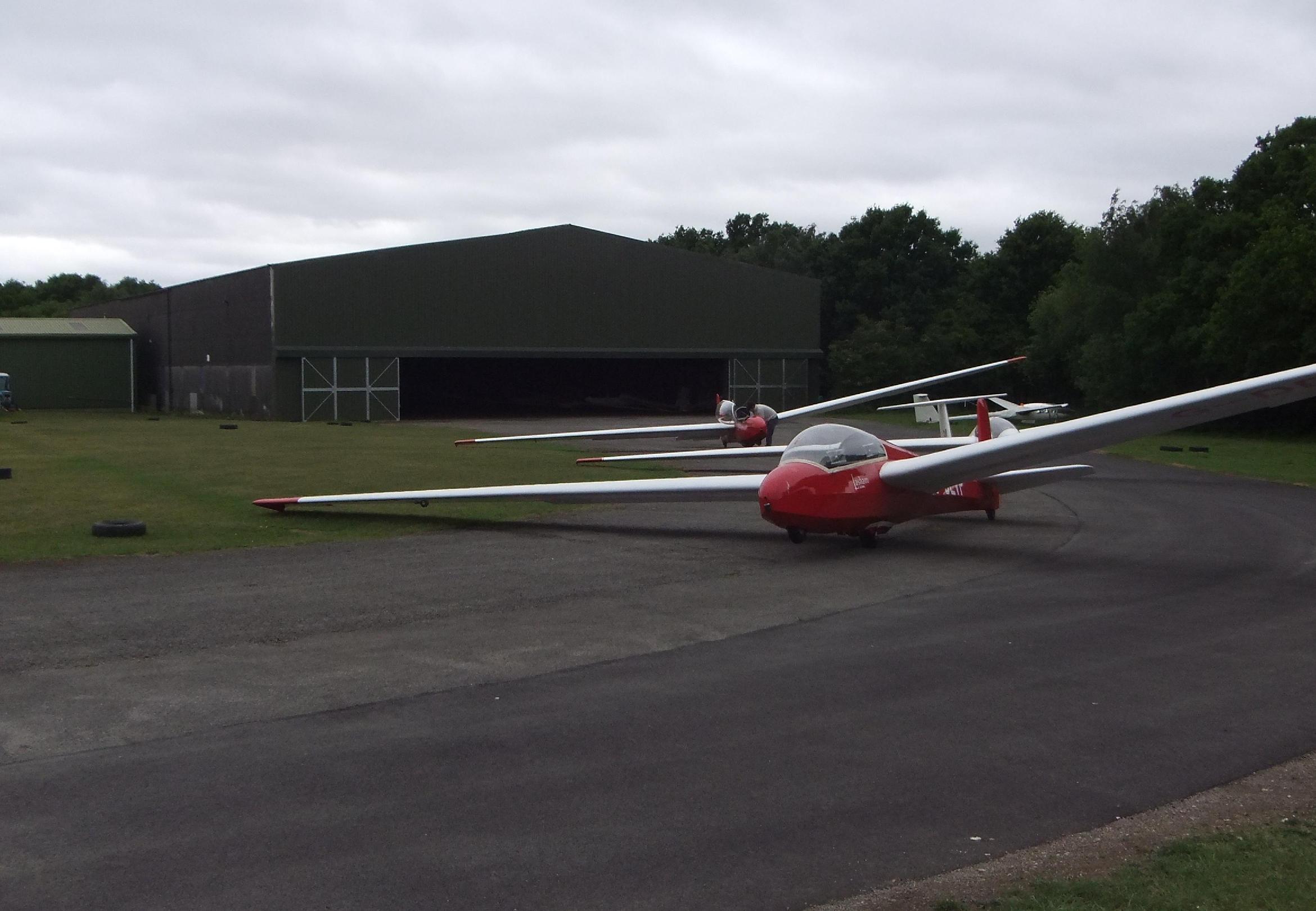
    Getting gliders ready for flying on a cloudy day.

    GLIDER CHRONICLES 2011 – May 4th : Soaring in Blue.

    Wed 4th May: Conditions: Westerly. Good soaring.

    Winch launch:

  • Launch attitude initially 10-15 degrees until 100-150’ (not all instructors agree on this), then pull back stick over 4secs into the climb.
  • Instructor notes:

  • 2 circuits and 2 launch failures. Ready for solo.
  • YES! Ready for solo! Great!

    Personal notes:

  • Good day. 8kts up by Oil Terminal to 4500’. Then flew twice around the airfield including down to Alton and back. Duration 1hr 4mins.
  • I want to say here that getting an hour’s flight from a winch launch is quite an accomplishment. On this day it was blue, i.e. no clouds to show you where you could find the thermals. So I was quite pleased, especially as when flying with the instructor I had been trying to stay on the south side of the airfield and not getting much lift. When solo however, I went to the north east where there is an oil “gathering” terminal and found what we call stonking lift up to the ceiling (max height) above Lasham that you can fly before going into an airway. (The airway is at 5500ft above sea level (amsl) and Lasham is 618ft amsl so you can only go up to about 4800ft. I decided to stop 300′ short – just in case.) In the end my bladder instructed me to descend. Silly, I know, but I wasn’t expecting this.

    On days like this you get home and feel really good. For me it is where theory meets the reality of nature.

    Wonderful.

    Waiting for a winch launch. Hopeful of lift at top of launch.

    GLIDER CHRONICLES 2011 – April

    So – back to the flying plot for 2011. I realised that I didn’t fly a glider at all in 2010, due to having made the most of the motorglider (pictured in the previous post) before it was sold off due to not being used enough. So it was now time for having a real drive to get back to solo standard and try and go for what is called the Bronze badge. This is a first step towards having the glider pilot’s license. All that is needed after that is a Cross-Country flying endorsement.

    So here is to a post to catch up with progress throughout April.

    Sat 23rd Apr: Conditions: (unknown)

    Personal notes:

  • First time back in a glider for over a year. Judgement is quite a way out, resulting in being far too high in the circuit. However, better that than too low.
  • Instructor notes:

  • 3 circuits. Tendency to be a bit high all around the circuit.
  • Mon 25th Apr: Conditions: Moderate crosswind.

    Instructor notes:

  • 3 wires in moderate crosswind. CBSA. Running out of height. Stall. Run out of height okay but need to recognise earlier – suggest spin, a higher cable break plus another run out of height before solo.
  • K13 about to be winch launched beside runway 27

    Sat 30th Apr: Conditions: Strong easterly.

    Landing:

  • In these conditions may need to fly it on to stop it ballooning.
  • Instructor notes:

  • 3 flights in strong winds. Practiced stalls, low spin and thermalling. 2 circuits with altimeter covered. Well flown.
  • I love it when they write “well flown”. Makes you feel as though you are getting somewhere.

    The Chronicles for May will be done day by day…

    GLIDER CHRONICLES 2009

    This is the first post of “The Glider Chronicles” which I thought some flying nuts would be interested in. They will be documenting my training experiences and you will be able to see how well or badly I am doing. I plan to include the hoary details of the instructor comments as well, although I will not name them! To be honest they are extremely good at Lasham. Generally the cognoscenti there have either (a) written the book, (b) advised the government, or (c) have enough flying hours to cover at least 100 lifetimes of my flying experience!

    However, we will start off with the past first, namely the halcyon year of 2009 when I actually got to fly solo in a glider! Note that although I may have what is called an NPPL (National Private Pilot’s Licence) to fly motor gliders this carries no weight (pun intended) when it comes to flying gliders.

    Later posts will be on a per flying day basis. This is mainly a catch up post.

    But first a pic of a busy launchpoint taken, if I remember rightly, on 28th October 2009 when we had the Lasham youth flyers.

    A busy day at the launchpoint. (Click to enlarge)

    More pics below.

    Wed 19th Aug: Conditions: Gusting southerly. Blue. Inversion @ 3000’.
    This was some of the first consistent glider flying I had done for 20 years. I still have the log book for that time. Yippee! So I am using the same logbook as when I started gliding in 1987.

    General:

  • Don’t forget Eventualities. CBSIFTCBE
  • [Pre-flight checks are: Controls; Ballast; Straps; Instruments; Flaps; Trim; Canopy; airBrakes; Eventualities]

    Winch Launch:

  • Get it onto the main wheel.
  • No need to pull back to get it to unstick.
  • At about 40’, with speed increasing through 50kts pull gently into climb.
  • Aerotow:

  • Keep above propwash on climb out otherwise it’s a fight. But not too high.
  • Demonstrated too high position.
  • Gentle movements.
  • Flying:

  • Speed control. Final turn: Fly looking front to get it well coordinated.
  • Don’t fixate on landing area otherwise speed control/coord goes.
  • Also wing is leaning into airfield due to fixation on landing area.
  • Trim to speed on downwind leg.
  • Don’t fiddle with airbrakes.
  • Instructor notes:

  • All flights improving. Speed control in flight okay – but speed control in circuit needs practice. Stalls and spins good. Circuit planning getting better. Don’t fiddle with brakes on approach. Boxing the wake good.
  • Sat 29th Aug 2009: Conditions: Gusting westerly. Good soaring.
    Still getting the hang of the winch launch at the moment. But managed to get some soaring in a thermal on this day.

    Winch launch:

  • Pull back on stick to more than 45deg if speed ok.
  • Don’t forget Eventualities. CBSIFTCBE
  • Circuit & Landings:

  • Pre-High key: Go through whatever checks you do. Don’t forget u/c.
  • Put approach speed on after low key.
  • Set brakes and hold setting unless undershooting.
  • Thermalling:

  • Lookout before turning
  • Tightening up on the lift is a good technique until more experienced.
  • Spin recovery:

  • To normal attitude to stop falling into another.
  • Instructor notes:

  • Strong wind conditions good soaring.
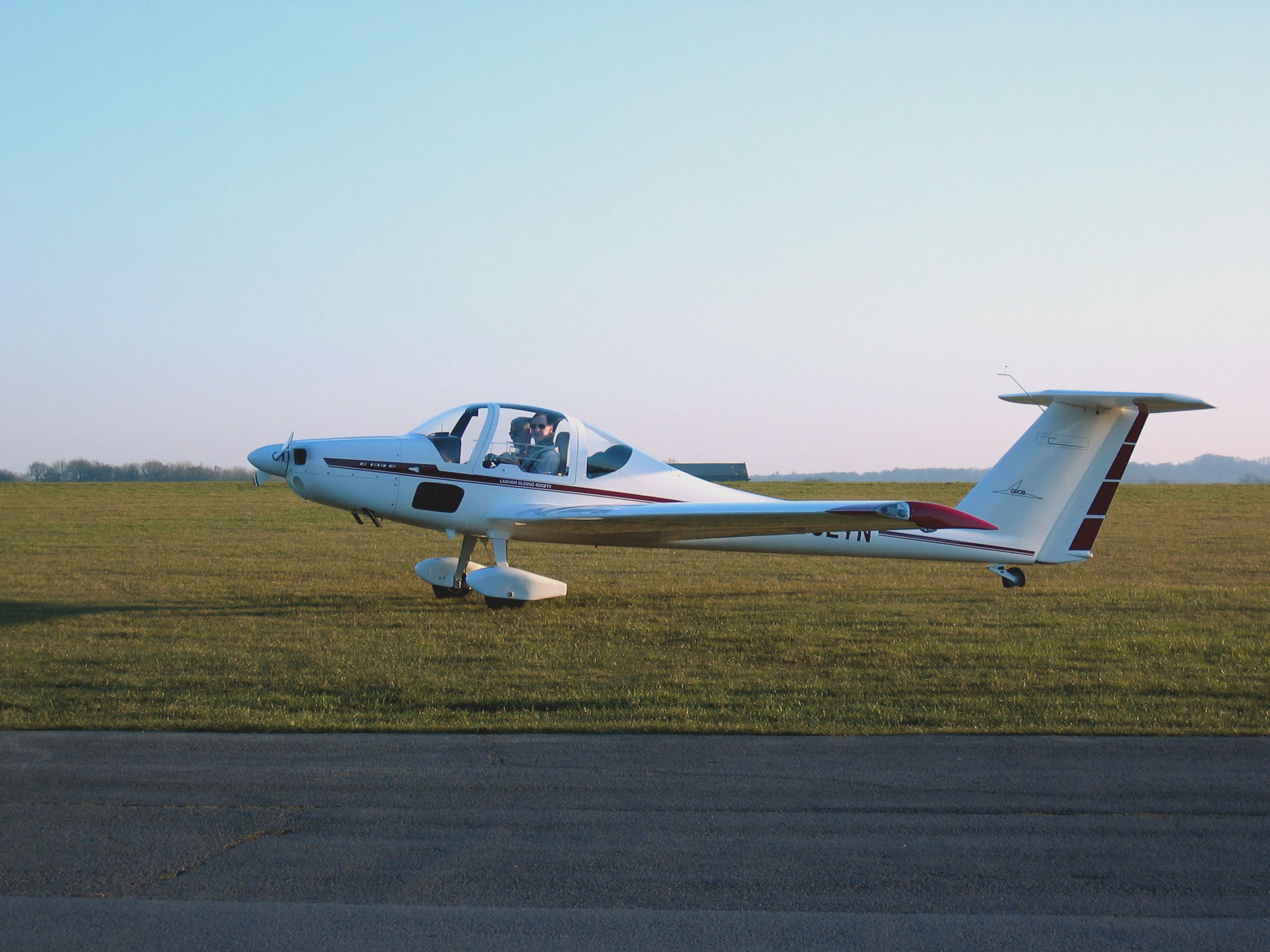
  • WHAT! What is a motorglider doing here! You may recognise this one from the header pic on this site.

    Grob 109 Motorglider for which I have a pilots license. Honest.

    Sat 5th Sep: Conditions: Gusting westerly.
    Some strong wind flying. Great fun. Also had to work my way around a landing jet at Lasham that had come in for a service.

    Winch launch:

  • Once airborne and speed ok, pull gently into fully back over 6secs.
  • AGAIN! Don’t forget Eventualities. CBSIFTCBE
  • Post launch checks are Trim set, Undercarriage up, Flaps set.
  • Circuit & Landings:

  • Pre-Landing checks: Wind/Water, Undercarriage, Landing area/Lookout, Flaps set, Straps secure.
  • Cable breaks: Get to approach speed after nose is down. (this day was 55kts)
  • Landing after jet movements: Jet takeoff: land short. Jet landing: land long.
  • Instructor notes:

  • Practiced cable breaks well flown first time
  • Sun 20th Sep: Conditions: Hazy, Light winds.
    MORE winch launch practice needed. By the way CBSA stands for Cable Break Straight Ahead, which is usually simulated by the instructor release the cable while you are in the 45degree climb! Good for negative G.

    Winch launch:

  • Don’t pull up too steeply on the initial climb.
  • Eventualities: In abbreviated circuit with some crosswind turn to downwind side.
  • Soaring:

  • Lookout before turning.
  • Don’t always need high bank angle. Glider not so efficient.
  • Circuit & Landing:

  • Put approach speed on downwind leg. 55kts even today in light winds.
  • Rounding out too early. Check view of attitude on the ground. Motorgliders sit higher.
  • Instructor notes:

  • Circuits, some soaring. 1 CBSA. Don’t pull up too fast on winch launch. Look out. General handling good. Needs cable breaks, stalling and spinning signed off.
  • Sat 26th Sep: Conditions: (unknown)
    Great! I got a chance to fly an aerotow.

    Instructor notes:

  • CBSA well flown. Aerotow boxing well controlled and generally very good.spinning exercises practised all okay.circuit without altimeter okay.if a little high.Suggest more cable break practice next.
  • Sat 10th Oct:Conditions: (unknown)

    Instructor notes 1:

  • Successfully did cable breaks, modified circuit. Circuits consistently a bit high. Next motor glider session to reinforce circuits.
  • Instructor notes 2:

  • 2 good circuits. Spin entry/spiral dive. No altimeter and power failure launch. Very good progress. Essentially the syllabus is complete.
  • Sun 18th Oct:Conditions: No wind.
    Now this was an interesting day. Absolutely NO wind. Which completely changed the way you have to plan your circuit. It is here where you find that modern gliders can fly for miles and miles.

    Instructor notes:

  • 3 good check flights. Calm wind conditions. Cleared for solo.
  • Observed first solo.
  • Good second solo.
  • Personal notes:

  • Completely different flying in nil wind conditions. Need to have space on final approach.
  • SOLO AT LAST!

    A happy Charles waiting for a solo flight on a lovely day in October.

    Mon 26th Oct: Conditions: Strong winds.
    Had one of the instructors demonstrate sideslips which basically involve turning the aircraft into a flying brick by making it go sideways through the air. Once again – Great fun!

    Instructor notes:

  • 2 check flights. Good reaction to cable break. Good landings and was flying in stronger winds.
  • Personal notes:

  • Solo soaring flight 19 min.
  • Evening sideslip approach with instructor.
  • Tues 27th Oct: Conditions: Strong winds.

    Instructor notes:

  • Strong wind. 800 foot launch. Overcast cloudy.
  • Personal notes:

  • Evening solo calm air practice sideslip
  • Sat 28th Nov: Conditions: Light winds.

    Winch launch:

  • Put stick just forward of centre pos & it should fly itself off ground.
  • Aerotow:

  • Come out to left to waggle wings to say cannot release. So easier for pilot to see you since he is seated on left.
  • Instructor notes:

  • 3 flights well handled. Stalls, reduced G, spin off shallow and steep turns, CBSA.
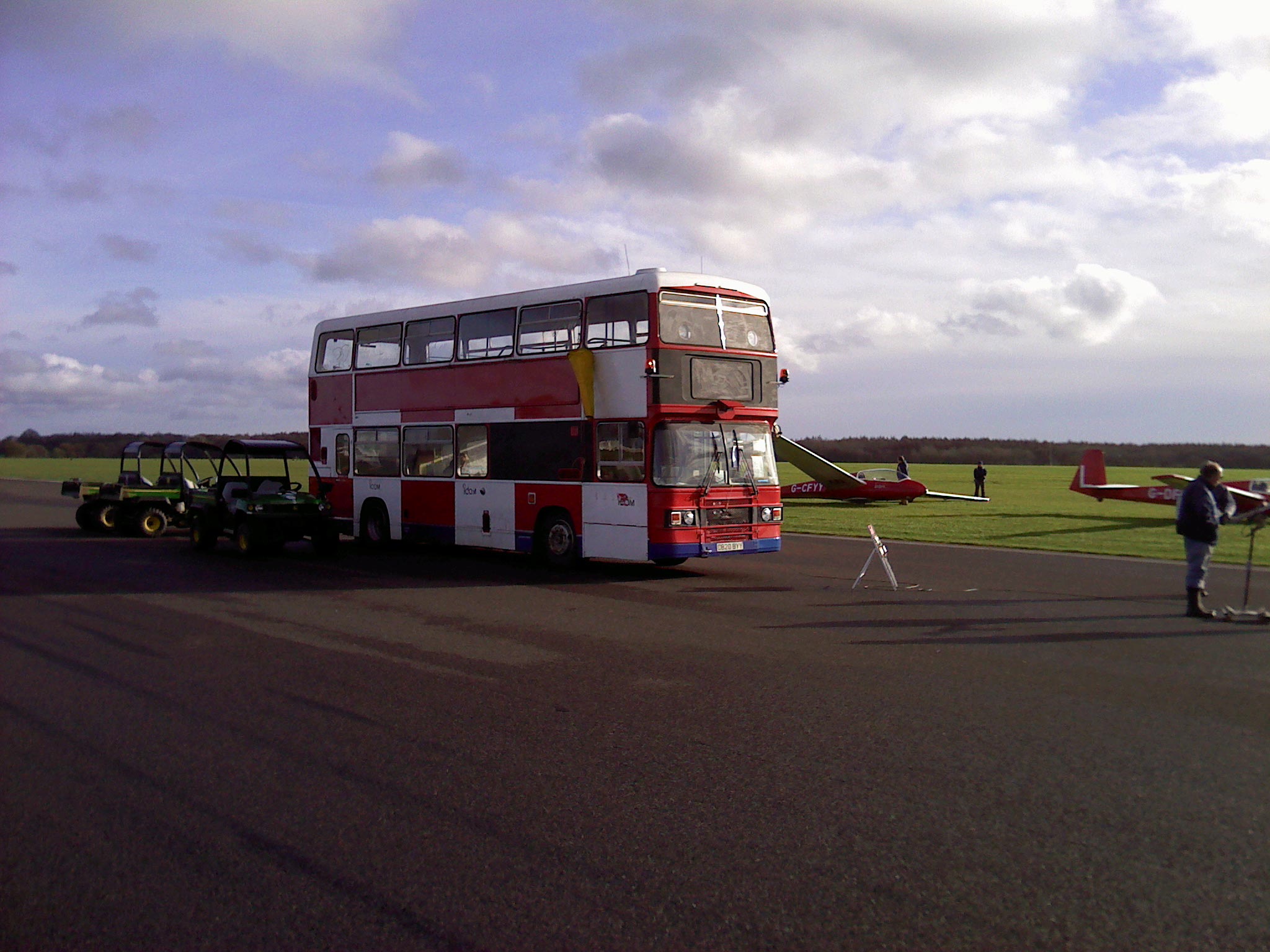
  • A picture of the launchpoint taken on 28-Nov-2009.

    The Lasham Launchpoint Bus in all its Glory.

    Sat 12th Dec: Conditions: 15kts NE crosswind. Cold. Moist.
    Now the notable thing about this day was that the instructor was an accomplished competition pilot. And just in case you think this is all just for the boys, the instructor was a lady. Very good comments about needing to fly more coordinated and to be more exacting with the general handling. That is one of the things I love about Lasham. There are some real experts there.

    General:

  • Be more focussed.
  • Don’t get caught out low downwind.
  • Must fly more coordinated. Keep string nailed central.
  • Instructor notes:

  • Problem circuit. Don’t get caught out low downwind! Need to fly better coordinated. Modified circuit flown well.
  • Then after this good start in 2009, I didn’t fly at all in 2010. So the next Chronicle will be from 2011 which will bring us almost up to date.

    See ya…

    Promises, Promises…

    Hello all
    Well once again it has been awhile since I have contributed to this blog.

    It has become clear to me that one of the last things I want to do when I get home is to sit in front of a computer and carry on typing after having spent all day in front of one writing software. However I still want to get my thoughts down.

    So to overcome this I decided to invest, partly as a test and partly out of interest, in a new toy. The toy in question is a copy of the speech recognition software called Dragon Naturally Speaking. As ever with any piece of technology it may take some adjustment but at the moment I am being pleasantly surprised about how effective it is. It does seem to need a computer with a fair amount of power and memory but I am finding it nicer to use than sitting typing. Of course there is always the chance that it is just a new toy 🙂 but if it helps me get my thoughts down here that is all to the good.

    So the process I have used for this post is to speak most of the text into the computer and then to edit it by hand thereafter.

    Having re-read the last post I realise that I have managed to find a rather good antidote to the problems of the enquiring mind. The answer is quite simple: Exercise, cycling to be exact.

    Anyway – down to business.

    I would like to connect some of the thoughts of one of my favourite thinkers that I highlighted in that last post, David Bohm, to some recent viewing I have been doing. His writings and comments related to a rather surprising subject (for me) that I normally do not deal with here. So I would like to warn you that I am going to deal with a politically loaded subject. Yet still strongly connected to how people can get stuck into patterns of thought thus leading to behaviour.

    We recently bought the DVD of the Channel 4 series “The Promise” and I have to say that this is not viewing you would want to watch just before going to bed. After every episode I would find my mind turning the issues over and over, each time coming back to certain thoughts which would invariably interfere with sleeping. Given also that recently I have read the book “Mornings in Jenin” by Susan Abulhawa which detailed the experiences of families from Ein Hod, there were quite a number of parallels as you would imagine.

    Let me say that I am well aware that these are works of fiction, but this doesn’t in any way reduce the value of the thinking one can do, and particularly the imagination of what life might be like for people caught in those conflicts.

    My impressions about this whole subject? I was mainly struck by how psychological damage rattles down through the generations. Although I am not so familiar with the details of what started World War 1, it was the reparations from that war that set the context for World War II. And it seems that that in turn set the context of the current crisis being played out in the Middle East. This stream of thought was driven by asking myself the question: How is it that the same mistakes keep getting made over and over again?

    So after World War I it was the Germans that were traumatised leading to their dire economic state. After World War II it was the Jews who were traumatised, thus leading to a violent birth of the state of Israel. If one allows oneself the luxury of standing right back from the details of the individual conflicts you can see this tragic progression of traumatisation from one group to another. It was at this point that I remembered David Bohm writing about thought as a system. It is as if the human race in conflict is being driven along like leaves in a storm, but of its own creating. I can well imagine that if one got caught up in the conflict in the Middle East now, one’s view would be affected by the particular experience one had, which in turn would dictate one’s sympathies, be it pro-Arab or pro-Israeli.

    The hard thing would be to hold oneself neutral and see the recurring behaviours. My goodness. Could I do that?

    So I wonder – would it be fair to think that we are being driven by our own unconscious thought processes. I don’t underestimate how strong the feelings may be for the individual but if the cycle of violence is not to be perpetuated the human race as a group has got to be able to step outside of certain trains of thought and strength of feeling.

    Or is that thinking all too detached? In my defence I can only say that my wish is to understand how to stop it happening again. Of course I have not been involved directly in the conflicts I have mentioned so who am I to comment upon them? But make no mistake : it is the weight of popular opinion that will be the strongest force in stopping a conflict. This has already happened in Northern Ireland among other places.

    To me – popular opinion is based upon the experience of families. In each example of conflict, the real tragedy is the effect that it has on family life and how people are catapulted out of a very loving environment into a horrible and violent situation. Thus the hurt children of one age become the soldiers of a subsequent one. If only those in power would, when making their decisions, consider in an imaginative way just what effect their deliberating will have on family life, then maybe there would be more reason to hope.

    Once again it is a case of thinking being too abstract rather than being imaginatively grounded in reality.

    I have experience of a situation where doting grandparents did not see their grandchildren for 10 years due to the fear and instability fostered by the prevailing political climate in the grandparent’s own country. It is so easy to spend time worrying about high level political changes going on but for me the reality of this aspect of the world can be seen in any airport arrivals terminal when you see the love and joy of families being reunited after long absences.

    Next time will be on a more upbeat note. Promise!

    Till the next time…

    Problems of the Inquiring (or Technological) Mind

    Well it has been a long while since I last posted here, and for that please accept my apologies, but there have been good reasons. I have been re-assessing life somewhat. I am hesitant to call it a mid-life crisis, since it feels like it has been happening for most of my life!

    One of the problems of having an inquiring mind, a curious mind, an analytical mind, is that you tend to deconstruct everything, i.e. you pull it apart. Sometimes there need to be boundaries as to what you will and what you will not pull apart. I must confess I have had problems with where to place those boundaries. And I think I am not alone in this. As I have mentioned before, the puzzle becomes the thing ,and if you have an analytical bent, you can easily forget why you wanted to solve the puzzle in the first place, or maybe sometimes you don’t even know, which means you are usually doing it just for fun.

    The impulse to re-assess has come from a number of directions and has a lot to do with a dawning realisation about just how damaging this sort of mind can be.

    Firstly has been my attendance at a Science conference in Stourbridge on a rainy weekend in late February (see footnote 1); secondly I have recently started reading what I am finding an inspiring management book called “Theory U” by Otto Scharmer (see footnote 2); and thirdly an article recommended by a friend about a breathtaking display of technological hubris by neurology professor, Henry Markram at the Ecole Polytechnique in Lausanne (see footnote 3).

    So what on earth is it that pulls all these threads together and is giving me such a hard time? Well… deep breath… I have been finding it harder and harder not to worry about various environmental concerns and bury my head in the technological sand, saying that we will be able to find solutions to the issues coming our way. A tipping point was when I watched a TV program about James Lovelock originally broadcast in April 2010 (Episode 2 of the “Beautiful Minds” series). Here is a man who is a great polymath and a scientist who is quite happy to be on the outside of the mainstream, pointing out the inherent problems of working within mainstream science at this time.

    These different threads have led me to the point where I feel very strongly that there are not just limits implicit in the current mode of thought we have, but that there is a fundamental flaw that is causing wide scale havoc with our environment.

    Favourite Metaphors, Quotes and Insights
    Thanks to the minds of various giants I like to think I am able to stand on their shoulders and have assembled here some of my favourite thoughts from them that, together, encapsulate some of what I am going on about.

    J.W. Goethe: Life is a Conversation. Ah yes, the wonderful idea of Delicate Empiricism.

    David Bohm: Thought as a System which creates the world and then says “I didn’t do it!”. So our collective thought is creating organisations which are prisons, and then we can blame the “system” for all the problems, which, remember, we have created.

    Rudolf Steiner: The problems of Dualism and the terrific difficulty of getting to Monism (which I link to a holistic way of seeing), though Henri Bortoft helps…

    Henri Bortoft: We cannot know the whole in the same way as we know a thing.
    This is worth more words here: The whole is not a thing. The way to the whole is through the parts. It is not to be encountered by stepping back and taking an overview. The whole is to be encountered by stepping into, and passing through, the parts.

    Couple these ideas with the realisation from my own experience of how difficult it is to recruit competent, thoughtful, software developers and perhaps you can see why I am going through a rather angst-ridden period.

    Conclusions
    So I have now come to realise that we must must must change the way we collectively think. Obviously this requires us to individually be more clear in our own thought, but there are issues of social technique that we need to learn, which I believe are key to how we turn this around. Now here is a kicker, there is a major link with the whole Risk Averse rant I usually bore friends with. The trouble with all this tech is that there is a risk of letting it do the thinking for us.

    My favourite example is the use of a satnav. I hate using a satnav that is telling me which way to turn. I once tested one and found its route choice to be flawed at best. No. I will choose the route thank you very much, and I will use the machine as a very useful map follower which traces where I am on the map. This is exactly what pilots are recommended to do when flying with a GPS. This is a prime of example of how to consciously use the technology.

    So… the link to risk aversion. Well if you do not consciously use the technology, you stop thinking. This is comfortable, but in the end, dangerous. It is also very convenient for any government. Since to have a population who are quite willing to follow orders is just fine by them. Risk aversion also puts you in a comfort zone. Again this means you stop thinking. Which is of course tied up with existence :-), as Descartes realised:

    I think therefore I am…

    And thats enough for now.
    See you soon.
    Thanks for reading.

    Footnotes
    1: This was Science from an anthroposophical perspective (the Steiner lot if you don’t know what the word means). I co-presented one session about the “Conscious use of technology”. The conference in general was a positive experience that has started me tentatively re-approaching some of Rudolf Steiner’s ideas. In preparation I read Paul Emberson’s book called “From Gondishapur to Silicon Valley” which I found a difficult read as I felt it was rather too evangelical about just how nasty our present computer technology is. In recent days I have come to have a better view of this, but more about that in a later post.

    2:
    I have found that, so far, the book called “Theory U” by Otto Scharmer is an inspiring read. It is early days as yet since I am about one third of the way through, but his insights from a personal perspective stop it being a dry book, for me at least, and I can relate to a lot of what is being said. His drive is to get to understand why we carry on doing things that are so destructive, and don’t seem to be able to change the results.

    3:
    A close friend sent me a link to an article in the Daily Mail about Prof Henry Markram trying to make a conscious computer system. As far as I can see this is all an effort to get some more funding and investment. His approach is breathtakingly short sighted and is yet another instance, to me, of someone playing with their toys.