GLIDER CHRONICLES 2011 – May 27th : Fire Thermal & Solo Aerotow.

This day had a surprising morning soaring flight in overcast conditions thanks to a bonfire on a farm, plus a couple of solo aerotow flights, representing a significant milestone on the way to being able to fly the single-seater glider fleet.

To give an idea of the cloud cover here is a picture – though taken 2 days later on the Sunday but with similar conditions.

K13 Launch on a cloudy day.

Fri 27th May: Conditions: Moderate cross wind from the north-west.

Instructor notes 1:

  • Check flights in K21. Run out of height + (winch) power failure well handled. Cleared for solo in crosswind conditions.
  • This was followed by 3 solo flights from the winch in overcast conditions so no sun reaching the ground. However, someone on a farm had lit a fire which triggered off thermal activity thus allowing me on one of the flights to scratch around until I managed to find a 4kts up thermal which took me up to cloudbase at 2000ft. This resulted in a flight time of 31mins which was above the threshold of half an hour for counting as a soaring flight from the winch.

    So once again I was feeling very pleased with myself given that it was completely overcast. Also to add to the big headed feeling, I saw someone else get an aerotow above me into the same area around the fire. However they were not able to connect to any lift and thus had to land before me.

    Instructor notes 2:

  • Aerotow well flown including out-of-position and boxing the tow. 2 solo tows well handled.
  • By the end of the day, although there was now some sun, the lift was very weak indeed. However it was nice to carry out a couple of solo aerotows to get these under my belt.

    Explanation of Boxing the Tow
    This is an exercise that is used to show that you are proficient at handling the aircraft during an aerotow. (An aerotow is where the glider gets pulled along behind a powered light aircraft called the Tug)

    Boxing the tow involves first descending lower than the tug aircraft. This requires the pilot to control the glider as it passes through the turbulent air from the propeller of the tug (the propwash) until it reaches the calmer air below it. You then have to fly the aircraft out to one side and hold it a short while. Then, staying on that side, fly up to level with the tug aircraft or slightly higher and hold… Then fly across to the other side of the tug at the same relative height and hold… Then again staying out to the side, descend to a height below that of the propwash and, you guessed it, hold… Then return to the starting position below the propwash before returning to the normal tow position behind the tug.

    If you do this well you will have described a nice rectangular flight path around the tug’s propwash, hence the term: Boxing the Tow. Great fun.

    Next step is to move onto getting ready to fly the Grob102 single seater, also known as an Astir.

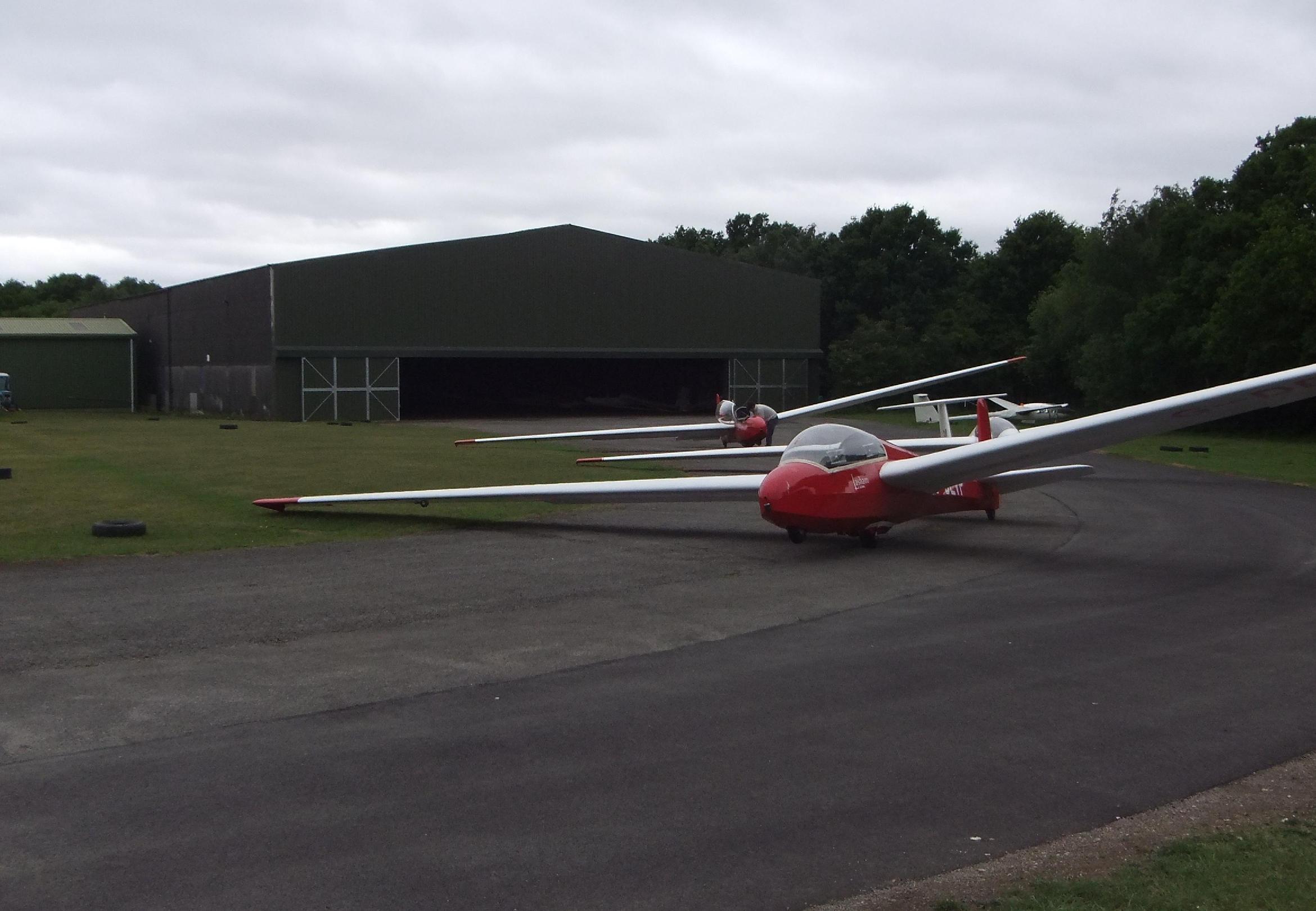
    Grob 102 picture from the Imperial College Gliding Club archive.

    Follow this link to the Imperial College Gliding Club archive to see the gliders that they have owned throughout the years.

    Coming up:
    Lasham Regionals Competition and flying log from the same wonderful day, once the weekend rain had passed.

    GLIDER CHRONICLES 2011 – May 21st : From Wood to Glass.

    No, not wedding anniversaries, but converting from flying wooden gliders to flying a glassfibre glider.

    Sat 21st May: Conditions: Strong south westerly.

    Instructor notes:

  • K21 conversion OK.
  • The K21 is a fibreglass glider and so is slippier in the air and needs a few adjustments to how it is flown compared to the wooden K13. It is used to get pilots ready for converting to flying the single seater Grob102 which is even slippier (apparently since as at this writing I have not flown it) and more “frisky”, shall we say.

    Since the wind was too gusty during the day, my instructor didn’t want me to fly it in the day, however the evening instructor was happy to allow it since the wind had died right down to calm.

    Personal notes:

  • Evening solo hangar flying the K21. Calm. Still found a little lift over the woods. Duration 8mins.
  • Interesting how the woods give off lift at the end of the day. Not much, but enough to scratch at for a short while, You don’t go up, but it is enough to stop the glider from descending in some areas.

    I am still getting used to this glider since it has a lot more what we call “adverse yaw” than the K13.

    Explanation of Adverse Yaw
    To explain adverse yaw I offer you this chance to exercise your inner child.

  • Put your arms out to the side like young children do when playing aeroplanes.
  • Then bank to the left.
  • At the same time turn your head to the left, towards your lower arm.
  • Yaw is what is happening with your head, and in this case is in the normal direction you would expect. Now assuming your inner child still has their arms out…

  • Bank to the left again.
  • This time turn your head to the RIGHT, towards your UPPER arm.
  • This is “adverse” yaw and with an aircraft only happens for a short while at the beginning of the turn. It happens because the wing which is going up, in this case your right hand, is asking for more lift than the left-hand. That is why the aircraft banks to the left. But asking for more lift from the wing produces more drag. So because the right wing has more drag than the left it goes more slowly, in this case twisting the aircraft to the right.

    When flying, to counteract this you have to put in more left hand rudder than normal, but only at the beginning of the turn.

    So… Now you, and your inner child, know about adverse yaw!

    OK. You can now give your inner child a rest.

    For those other thinkers out there, you will notice that the inner child’s experiential knowledge is different to the adult’s “head” knowledge. To properly experience this difference you must let your inner child play the game in reality. Go on, you can do it. so what if your family and/or friends and colleagues think you are crazy. It’s not you, it’s your inner child. 🙂

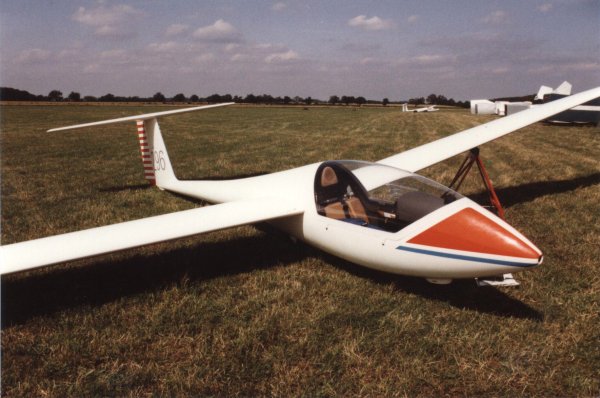
    The K21 in question.

    A reminder of the K13 wooden glider.

    Coming soon:

  • Thermalling above a fire…
  • Lasham Regionals Gliding competition, with more photos…
  • GLIDER CHRONICLES 2011 – May 13th : Friday – lucky for some.

    Not a time to be superstitious. I admit that some doubtful thoughts crossed my mind on the evening before, but by the time I was at the flying club, all that was forgotten and I just had a great day.

    The instructor this time was the guy who wrote the book about winch launching! So managed to get the real info on how to do it and the issues involved. This is one of the applications where the practical use of mathematics really comes to the fore. Why? Well, one aspect is that if you pull up into the main climb too fast you are trying to increase the vertical component of your speed too quickly, and guess what? This mistake can kill you! Hence all the training and training about it.

    Follow this link to some video simulations on the British Gliding Association (BGA) website. Suffice it to say that this safe winch launching drive have resulted in a significant reduction in accidents over the last 5 to 10 years. Good job.

    Fri 13th May: Conditions: South westerly. Gusty. Ragged soaring.

    Winch launch:

  • Look at BGA website re: launching.
  • No time to worry about getting onto main wheel since it all happens too fast. Just keep glider in a shallow climb until accelerating through 50kts. Look for 50kts on ASI and just feel for the acceleration in seat of pants.
  • Then gradually go into full climb over 3-4secs. Don’t change attitude too quickly. This can kill.
  • Use judgement in the moment, rather than relying on pre-thought out decisions.
  • Instructor notes:

  • Good winch launch. Running out of height exercise showed good judgement associated with safe handling. OK for solo.
  • Personal notes:

  • 4pm flight. Real tussle to stay up. Duration 1hr 1min.
  • Another great flight, but late in the day when the lift was dying since the sun is lower. Found a brown field (i.e. no crop) which was giving scrappy lift but, lift nonetheless. A real hard long fight as much as a flight. Still felt great after that accomplishment.

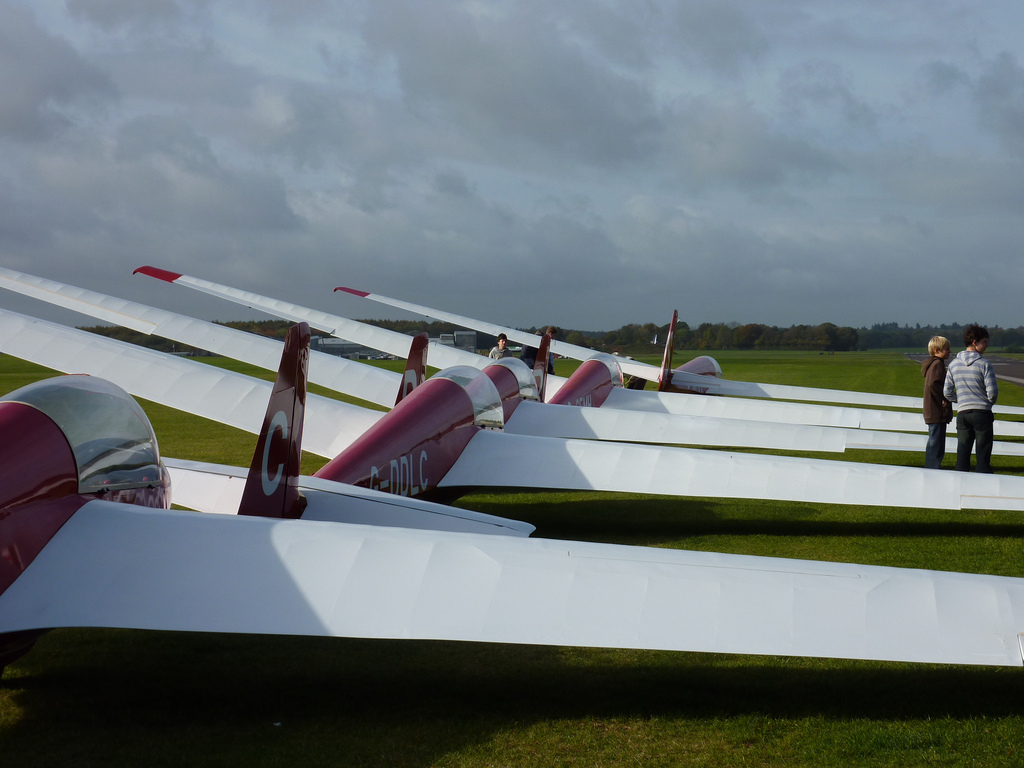
    Getting gliders ready for flying on a cloudy day.

    GLIDER CHRONICLES 2011 – May 4th : Soaring in Blue.

    Wed 4th May: Conditions: Westerly. Good soaring.

    Winch launch:

  • Launch attitude initially 10-15 degrees until 100-150’ (not all instructors agree on this), then pull back stick over 4secs into the climb.
  • Instructor notes:

  • 2 circuits and 2 launch failures. Ready for solo.
  • YES! Ready for solo! Great!

    Personal notes:

  • Good day. 8kts up by Oil Terminal to 4500’. Then flew twice around the airfield including down to Alton and back. Duration 1hr 4mins.
  • I want to say here that getting an hour’s flight from a winch launch is quite an accomplishment. On this day it was blue, i.e. no clouds to show you where you could find the thermals. So I was quite pleased, especially as when flying with the instructor I had been trying to stay on the south side of the airfield and not getting much lift. When solo however, I went to the north east where there is an oil “gathering” terminal and found what we call stonking lift up to the ceiling (max height) above Lasham that you can fly before going into an airway. (The airway is at 5500ft above sea level (amsl) and Lasham is 618ft amsl so you can only go up to about 4800ft. I decided to stop 300′ short – just in case.) In the end my bladder instructed me to descend. Silly, I know, but I wasn’t expecting this.

    On days like this you get home and feel really good. For me it is where theory meets the reality of nature.

    Wonderful.

    Waiting for a winch launch. Hopeful of lift at top of launch.

    GLIDER CHRONICLES 2011 – April

    So – back to the flying plot for 2011. I realised that I didn’t fly a glider at all in 2010, due to having made the most of the motorglider (pictured in the previous post) before it was sold off due to not being used enough. So it was now time for having a real drive to get back to solo standard and try and go for what is called the Bronze badge. This is a first step towards having the glider pilot’s license. All that is needed after that is a Cross-Country flying endorsement.

    So here is to a post to catch up with progress throughout April.

    Sat 23rd Apr: Conditions: (unknown)

    Personal notes:

  • First time back in a glider for over a year. Judgement is quite a way out, resulting in being far too high in the circuit. However, better that than too low.
  • Instructor notes:

  • 3 circuits. Tendency to be a bit high all around the circuit.
  • Mon 25th Apr: Conditions: Moderate crosswind.

    Instructor notes:

  • 3 wires in moderate crosswind. CBSA. Running out of height. Stall. Run out of height okay but need to recognise earlier – suggest spin, a higher cable break plus another run out of height before solo.
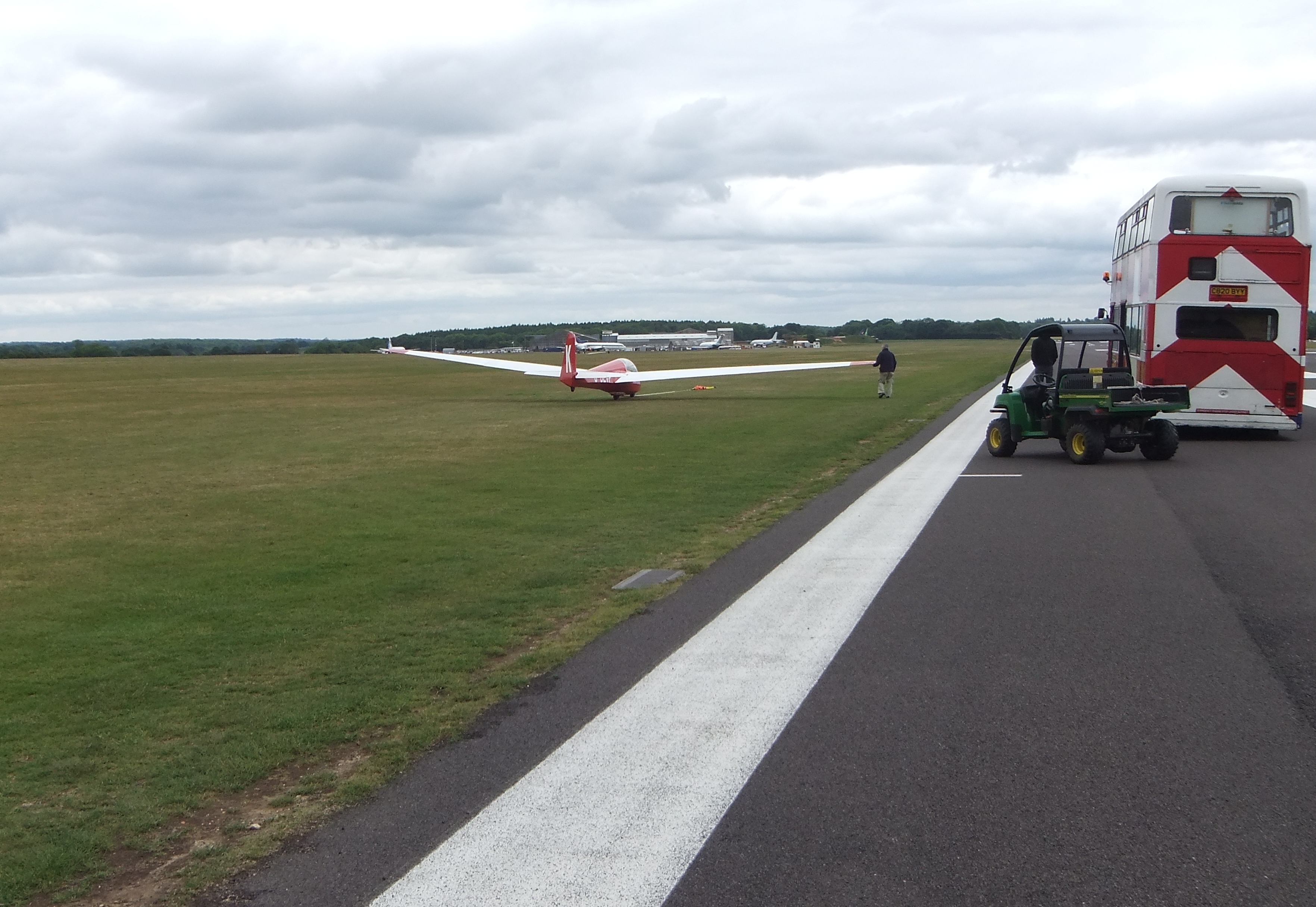
  • K13 about to be winch launched beside runway 27

    Sat 30th Apr: Conditions: Strong easterly.

    Landing:

  • In these conditions may need to fly it on to stop it ballooning.
  • Instructor notes:

  • 3 flights in strong winds. Practiced stalls, low spin and thermalling. 2 circuits with altimeter covered. Well flown.
  • I love it when they write “well flown”. Makes you feel as though you are getting somewhere.

    The Chronicles for May will be done day by day…

    GLIDER CHRONICLES 2009

    This is the first post of “The Glider Chronicles” which I thought some flying nuts would be interested in. They will be documenting my training experiences and you will be able to see how well or badly I am doing. I plan to include the hoary details of the instructor comments as well, although I will not name them! To be honest they are extremely good at Lasham. Generally the cognoscenti there have either (a) written the book, (b) advised the government, or (c) have enough flying hours to cover at least 100 lifetimes of my flying experience!

    However, we will start off with the past first, namely the halcyon year of 2009 when I actually got to fly solo in a glider! Note that although I may have what is called an NPPL (National Private Pilot’s Licence) to fly motor gliders this carries no weight (pun intended) when it comes to flying gliders.

    Later posts will be on a per flying day basis. This is mainly a catch up post.

    But first a pic of a busy launchpoint taken, if I remember rightly, on 28th October 2009 when we had the Lasham youth flyers.

    A busy day at the launchpoint. (Click to enlarge)

    More pics below.

    Wed 19th Aug: Conditions: Gusting southerly. Blue. Inversion @ 3000’.
    This was some of the first consistent glider flying I had done for 20 years. I still have the log book for that time. Yippee! So I am using the same logbook as when I started gliding in 1987.

    General:

  • Don’t forget Eventualities. CBSIFTCBE
  • [Pre-flight checks are: Controls; Ballast; Straps; Instruments; Flaps; Trim; Canopy; airBrakes; Eventualities]

    Winch Launch:

  • Get it onto the main wheel.
  • No need to pull back to get it to unstick.
  • At about 40’, with speed increasing through 50kts pull gently into climb.
  • Aerotow:

  • Keep above propwash on climb out otherwise it’s a fight. But not too high.
  • Demonstrated too high position.
  • Gentle movements.
  • Flying:

  • Speed control. Final turn: Fly looking front to get it well coordinated.
  • Don’t fixate on landing area otherwise speed control/coord goes.
  • Also wing is leaning into airfield due to fixation on landing area.
  • Trim to speed on downwind leg.
  • Don’t fiddle with airbrakes.
  • Instructor notes:

  • All flights improving. Speed control in flight okay – but speed control in circuit needs practice. Stalls and spins good. Circuit planning getting better. Don’t fiddle with brakes on approach. Boxing the wake good.
  • Sat 29th Aug 2009: Conditions: Gusting westerly. Good soaring.
    Still getting the hang of the winch launch at the moment. But managed to get some soaring in a thermal on this day.

    Winch launch:

  • Pull back on stick to more than 45deg if speed ok.
  • Don’t forget Eventualities. CBSIFTCBE
  • Circuit & Landings:

  • Pre-High key: Go through whatever checks you do. Don’t forget u/c.
  • Put approach speed on after low key.
  • Set brakes and hold setting unless undershooting.
  • Thermalling:

  • Lookout before turning
  • Tightening up on the lift is a good technique until more experienced.
  • Spin recovery:

  • To normal attitude to stop falling into another.
  • Instructor notes:

  • Strong wind conditions good soaring.
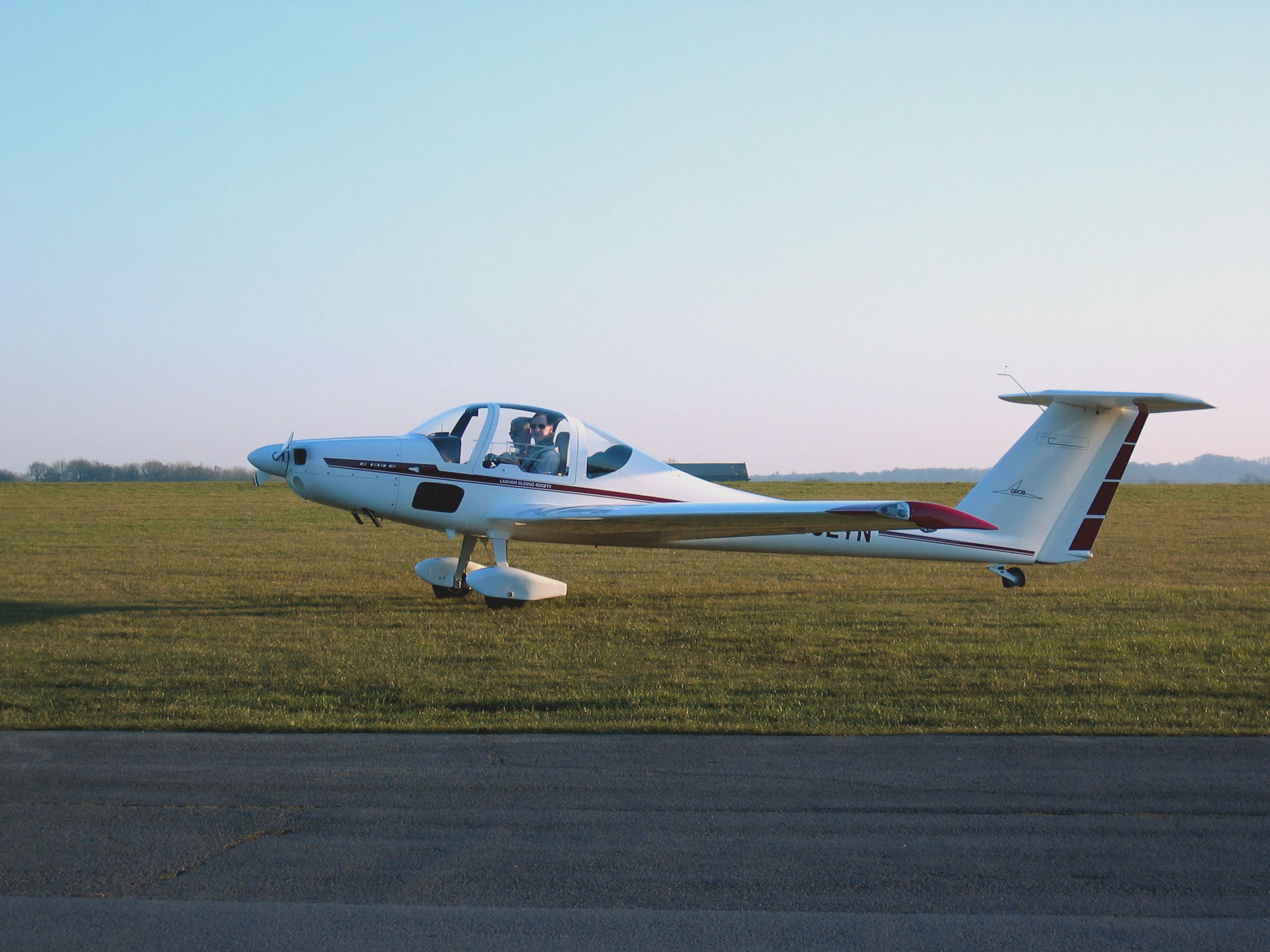
  • WHAT! What is a motorglider doing here! You may recognise this one from the header pic on this site.

    Grob 109 Motorglider for which I have a pilots license. Honest.

    Sat 5th Sep: Conditions: Gusting westerly.
    Some strong wind flying. Great fun. Also had to work my way around a landing jet at Lasham that had come in for a service.

    Winch launch:

  • Once airborne and speed ok, pull gently into fully back over 6secs.
  • AGAIN! Don’t forget Eventualities. CBSIFTCBE
  • Post launch checks are Trim set, Undercarriage up, Flaps set.
  • Circuit & Landings:

  • Pre-Landing checks: Wind/Water, Undercarriage, Landing area/Lookout, Flaps set, Straps secure.
  • Cable breaks: Get to approach speed after nose is down. (this day was 55kts)
  • Landing after jet movements: Jet takeoff: land short. Jet landing: land long.
  • Instructor notes:

  • Practiced cable breaks well flown first time
  • Sun 20th Sep: Conditions: Hazy, Light winds.
    MORE winch launch practice needed. By the way CBSA stands for Cable Break Straight Ahead, which is usually simulated by the instructor release the cable while you are in the 45degree climb! Good for negative G.

    Winch launch:

  • Don’t pull up too steeply on the initial climb.
  • Eventualities: In abbreviated circuit with some crosswind turn to downwind side.
  • Soaring:

  • Lookout before turning.
  • Don’t always need high bank angle. Glider not so efficient.
  • Circuit & Landing:

  • Put approach speed on downwind leg. 55kts even today in light winds.
  • Rounding out too early. Check view of attitude on the ground. Motorgliders sit higher.
  • Instructor notes:

  • Circuits, some soaring. 1 CBSA. Don’t pull up too fast on winch launch. Look out. General handling good. Needs cable breaks, stalling and spinning signed off.
  • Sat 26th Sep: Conditions: (unknown)
    Great! I got a chance to fly an aerotow.

    Instructor notes:

  • CBSA well flown. Aerotow boxing well controlled and generally very good.spinning exercises practised all okay.circuit without altimeter okay.if a little high.Suggest more cable break practice next.
  • Sat 10th Oct:Conditions: (unknown)

    Instructor notes 1:

  • Successfully did cable breaks, modified circuit. Circuits consistently a bit high. Next motor glider session to reinforce circuits.
  • Instructor notes 2:

  • 2 good circuits. Spin entry/spiral dive. No altimeter and power failure launch. Very good progress. Essentially the syllabus is complete.
  • Sun 18th Oct:Conditions: No wind.
    Now this was an interesting day. Absolutely NO wind. Which completely changed the way you have to plan your circuit. It is here where you find that modern gliders can fly for miles and miles.

    Instructor notes:

  • 3 good check flights. Calm wind conditions. Cleared for solo.
  • Observed first solo.
  • Good second solo.
  • Personal notes:

  • Completely different flying in nil wind conditions. Need to have space on final approach.
  • SOLO AT LAST!

    A happy Charles waiting for a solo flight on a lovely day in October.

    Mon 26th Oct: Conditions: Strong winds.
    Had one of the instructors demonstrate sideslips which basically involve turning the aircraft into a flying brick by making it go sideways through the air. Once again – Great fun!

    Instructor notes:

  • 2 check flights. Good reaction to cable break. Good landings and was flying in stronger winds.
  • Personal notes:

  • Solo soaring flight 19 min.
  • Evening sideslip approach with instructor.
  • Tues 27th Oct: Conditions: Strong winds.

    Instructor notes:

  • Strong wind. 800 foot launch. Overcast cloudy.
  • Personal notes:

  • Evening solo calm air practice sideslip
  • Sat 28th Nov: Conditions: Light winds.

    Winch launch:

  • Put stick just forward of centre pos & it should fly itself off ground.
  • Aerotow:

  • Come out to left to waggle wings to say cannot release. So easier for pilot to see you since he is seated on left.
  • Instructor notes:

  • 3 flights well handled. Stalls, reduced G, spin off shallow and steep turns, CBSA.
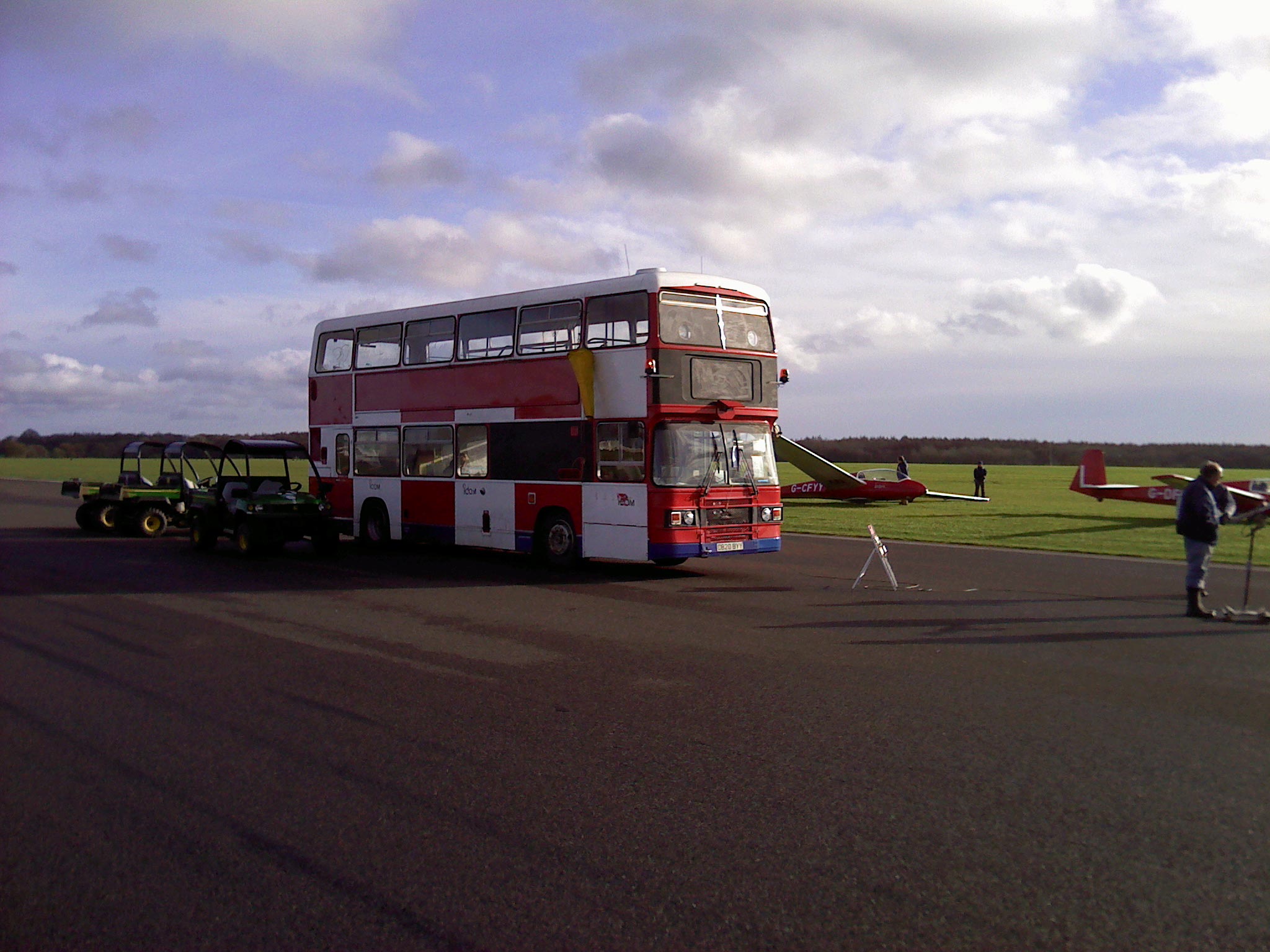
  • A picture of the launchpoint taken on 28-Nov-2009.

    The Lasham Launchpoint Bus in all its Glory.

    Sat 12th Dec: Conditions: 15kts NE crosswind. Cold. Moist.
    Now the notable thing about this day was that the instructor was an accomplished competition pilot. And just in case you think this is all just for the boys, the instructor was a lady. Very good comments about needing to fly more coordinated and to be more exacting with the general handling. That is one of the things I love about Lasham. There are some real experts there.

    General:

  • Be more focussed.
  • Don’t get caught out low downwind.
  • Must fly more coordinated. Keep string nailed central.
  • Instructor notes:

  • Problem circuit. Don’t get caught out low downwind! Need to fly better coordinated. Modified circuit flown well.
  • Then after this good start in 2009, I didn’t fly at all in 2010. So the next Chronicle will be from 2011 which will bring us almost up to date.

    See ya…
    Theory Meets Practice – and saves lives

    On Feb 15th I spent some time at Lasham where I fly gliders, helping out with the Lasham Cadets. Unfortunately the weather was not good enough for flying so we had some talks. The cadets had to give a talk about various aspects of the theory of flying gliders, whereas the adults gave a mixed set of talks about work they have done.

    I want to focus on a particular talk given by one of the parents who is a professional in the aviation industry, previously having been a pilot, now also flying gliders. He was making a point about the importance of being able to link theoretical knowledge to practical application, in this case about the theory of flight and saving lives.

    The subject he chose was the accident at Heathrow on 17th Jan 2008 where a Boeing 777 lost power before landing and just managed to touchdown inside the airport but short of the runway. He was particularly highlighting the actions of the captain and the effect it had on the outcome.

    Background
    As a preamble it is worth noting the layout of the ground on the runway approach in question, 27L. From the airport boundary fence there is about a 1700ft gap before the runway paved surface starts. Here is a detailed map for the flying nerds among us. Just before the airfield fence you have the main A30 road which is a very busy highway. According to the AAIB report S1/2008 the aircraft touched down “some 1000ft short of the paved runway surface”, so there was only 700ft or so between the touchdown point and the road.

    However, the key statement is in the interim report on page 4 where is says: “At 240 ft the aircraft commander selected flap 25 in an attempt to reduce the drag”. According to the person giving us the rainy day talk at Lasham, this action is not mentioned in any training, although it will be known by pilots because the effect of flaps is a basic theory of flight item.

    Some Theory of Flight
    So what are flaps and what do they do? On an airliner they are like big barn doors that, when down, extend from the rear of the wing. They allow the pilot to increase the lift from the wing at slower speeds. Depending upon the aircraft and their setting they also adjust the angle the aircraft flies at so that visibility is usually better for landing. In this case they had 30 degrees of flap which will have given them a slow flying, high visibility approach. Since with physics, you never get something for nothing, the down side will have been the high drag. In this case the autopilot will have been countering this drag with more thrust from the engines because at 30degrees the flaps were giving more drag than lift.

    Handling the Emergency
    Looking at the approach graph, when the engines gave up, although the glide angle was fairly constant, the airspeed was fluctuating and falling rapidly at some points. This could only go on for so long before the aircraft would have slowed down too far and fallen out of the sky, quite possibly onto the A30 dual carriageway. When the commander selected 25degrees of flap, although the glide angle steepened temporarily, it reduced the drag so that the airspeed stopped falling and the aircraft was able to glide a bit further than it would have done with the 30degrees setting. This would have taken courage because just after reducing the flap there was less lift from the wing so the aircraft lost some height before it stabilised on a better glide angle.

    Conclusions
    In any pilot’s training the effects of controls like this are covered. It is something that is relevant regardless of the type of aircraft you are flying. It works just as well for a glider as it does for a 200-400 seater airliner. Luckily what happened here was that the pilot had internalised the theory of flight enough to make the right judgement in an emergency, even though the initial response of the aircraft was going to be losing more height, something he would have known.

    He managed to make that important link between theory and practice.

    The Moral
    Although technology can be made to work well a lot of the time, when an emergency occurs you will be vulnerable. A successful outcome will depend upon making the link between theory and practice. It will not be an academic exercise.